President Yoweri Museveni has said that the Scripture Union’s belief that divine intervention alone can sustain individuals is not right.
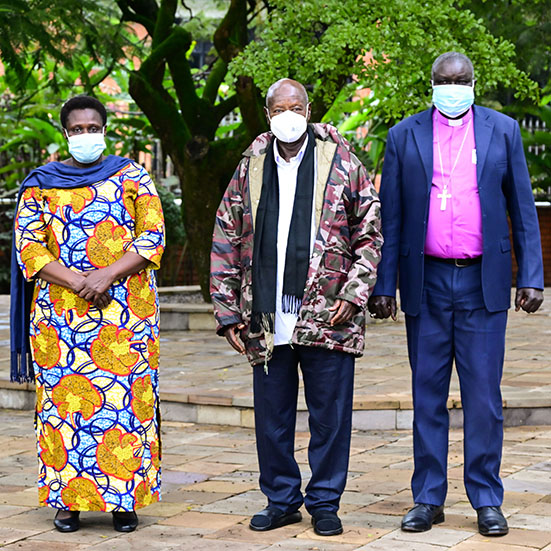
“I don’t agree with the notion that God will provide for those who do not work. As a religious leader, you must exemplify the values you teach” Museveni told Rt. Rev. John Okude Omuse, the Bishop of the Anglican church of Kenya-Katakwa diocese who had paid a visit to him at Nakasero State lodge.

“If you are poor and struggling, what message does that send to your community? A body that is hungry and sick cannot truly embody the temple of God.” he noted during his interaction with the Man of God whose visit was coordinated by Maj. Jessica Alupo, the Vice President.
Museveni emphasized the importance of self-reliance and responsibility, arguing that faith must be accompanied by diligent effort to foster both individual and community development.
WEALTH CREATION
The President therefore, shared insights on wealth creation and the successful practices Uganda has employed to transition its citizens from subsistence farming to active participation in the money economy.
He said when he came into power, cotton was the main cash crop among the Itesots here in Uganda.
“I advised them that they needed to shift from that because it wasn’t logical for some households to have small pieces of land and grow cotton. I told them they need to grow fruits like mangoes, pineapples, and oranges.” he said adding that the adoption of these crops, along with cotton and poultry farming has led to better livelihoods in Uganda.
Museveni identified seven key enterprises for the delegation to consider when carrying out commercial agriculture. These include coffee; fruits, especially mangoes, oranges, pineapples, apples, and grapes; zero-grazing dairy farming; fish-farming; poultry for eggs; piggery; and homestead food crops cassava, bananas, among others.
“People who have listened to this message are doing well,” he noted.
The President also addressed the need for free trade in foodstuffs explaining that this will create prosperity among the people of East Africa.
“It would prevent issues of scarcity of food in one country when there is plenty in another,” he noted adding that ‘Rationality cannot be ignored indefinitely. We shall continue discussing with our EAC Partners, and I am sure we shall end up with a real common market, free of non-tariff barriers because those barriers hurt the wanainchi of all our countries’

Meanwhile, Bishop Okude expressed his gratitude to President Museveni for his visionary leadership.
“Your Excellency, you are the father of our region, East Africa. We can’t commend you enough for your continuous dedication and support you render to your fellow leaders and us the citizens,” he said and also highlighted the pressing agricultural challenges facing the Iteso community in Katakwa.
“The limited cash crops and ineffective agricultural practices are severely hindering economic growth in our region,” he stated adding that little agricultural activity is taking place among the Itesots which he said is detrimental to their economic well-being.
It should be noted that Iteso Clan groups are both in Uganda and Kenya.
In Kenya, the Iteso people live in Western Province- Busia County whereas in Uganda they live in the Eastern Region. Bishop Okude was accompanied by his wife Grace Nanjala and other leaders.