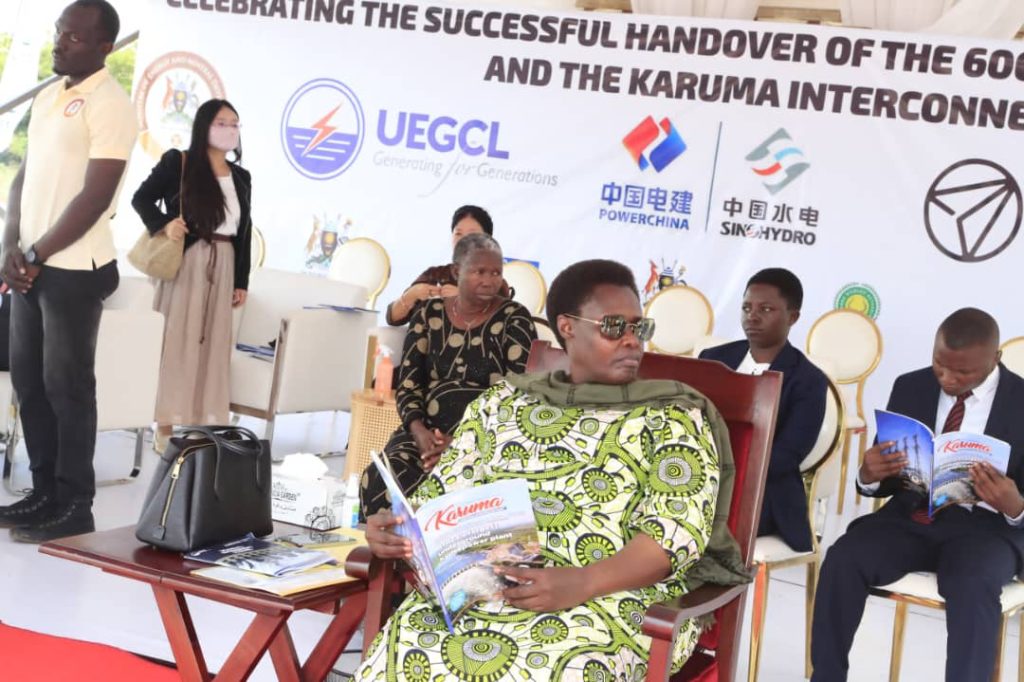
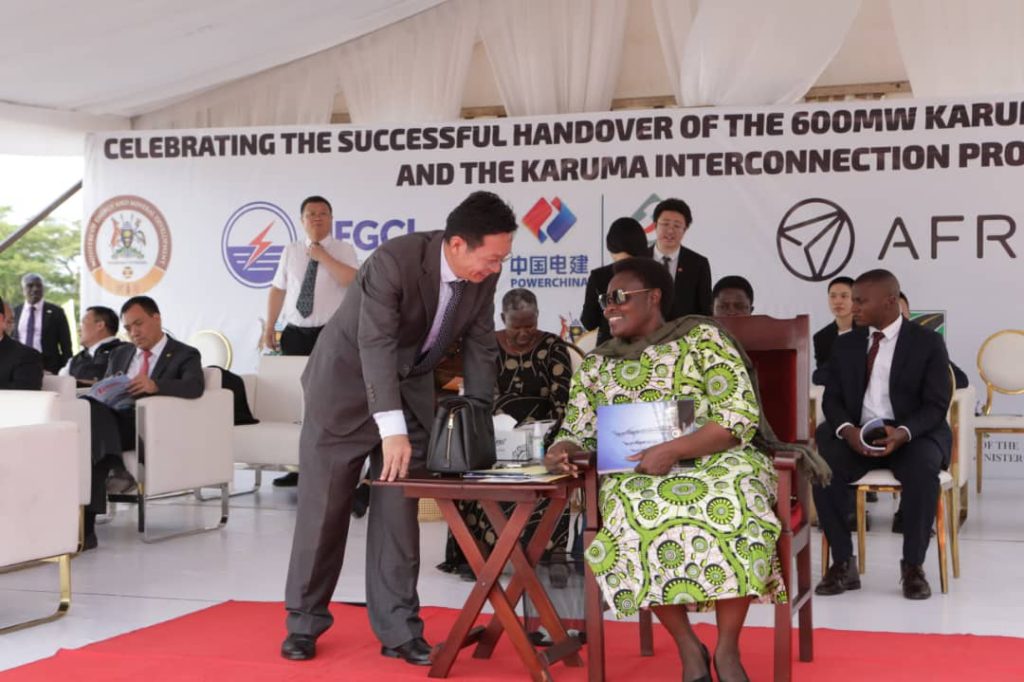
Vice President Maj. Jessica Alupo has hailed the commissioning of the Karuma Hydropower Project, describing it as a significant milestone to drive Uganda’s Vision 2040 and the National Development Plans.
She says the project which was commissioned today by President Yoweri Museveni, serves as a catalyst for economic growth, industrial expansion and improved livelihoods for the wanainchi.

Alupo told the function officiated by her boss in Kiryandongo that the launch of Karuma also lies within the dictates of the 2021 NRM manifesto which recognizes the central role of electricity in Uganda’s development.
“Electricity impacts a wide range of development indicators, including health, education, food security, gender equality, livelihoods and poverty reduction” she said.
Alupo said Karuma launch also proves Uganda’s commitment towards achieving its global aspirations including Social Development Goal No. 7 which aims to achieve Electricity for All target by 2030, while at the same time the project fits in well with East African Community (EAC) Vision 2050 that sets an ambitious target of increasing the energy production from 3,965MW in 2014 to an estimated 70,570MW.
“This project demonstrates that Uganda is not only focusing on generating more electricity but also on ensuring that this energy is affordable, reliable, and accessible to all Ugandans. It is a clear indication of our government’s strategic approach to uplifting every sector of society through the provision of energy—a vital ingredient for national development” Alupo who is also Katakwi district Woman MP said.
She commended the commissioning of the Karuma Hydropower Plant as it adds 600 megawatts to Uganda’s power generation capacity, bringing our total capacity to about 2,000 megawatts.
Alupo also noted that such a project shows government’s ability to harness Uganda’s abundant natural resources to meet the country’s growing energy demands.
“We are all aware that energy is the backbone of industrialization. With this new supply, we are now better positioned to attract investments, boost industrial production, and enhance the competitiveness of our economy.
Beyond that, this project also reaffirms our commitment to a sustainable future, as hydropower is a renewable energy source that will contribute to Uganda’s energy transition and environmental sustainability” she said.
On the social front, Alupo noted that the surrounding communities have benefited immensely through corporate social responsibility initiatives where Hospitals, schools, and other social amenities constructed as part of this project have significantly improved the quality of life for the local population.
“As we look to the future, the Karuma Hydropower Project serves as a stepping stone for greater achievements in our energy sector. Uganda’s goal of reaching 52,000 MW of generation capacity by 2040 is ambitious but within reach, thanks to projects like this” she said.

The Vice President said government will continue to prioritize investments in renewable energy, including solar, wind, and geothermal power, as the country works towards creating a diverse and resilient energy mix.
She commended all government agencies and development partners for making the project achievable.
Alupo cited Sinohydro Corporation, Chinese government and the Exim Bank of China for their support in financing the project.
“And as part of this year’s FOCAC discussion, the Government of the People’s Republic of China indicated its readiness to invest in new electricity projects. Your Excellency, today’s commissioning of the Karuma Hydropower Project is a profound moment for Uganda. It marks not just the culmination of years of hard work and collaboration, but also the beginning of a new chapter in our energy story.” She noted before showering praises on her boss Gen. Museveni for his visionary leadership.