
President Museveni has emphasized the need to strengthen Alternative Dispute Resolution (ADR) mechanisms, saying their expansion to grassroots levels ensures a more effective and affordable means of justice.
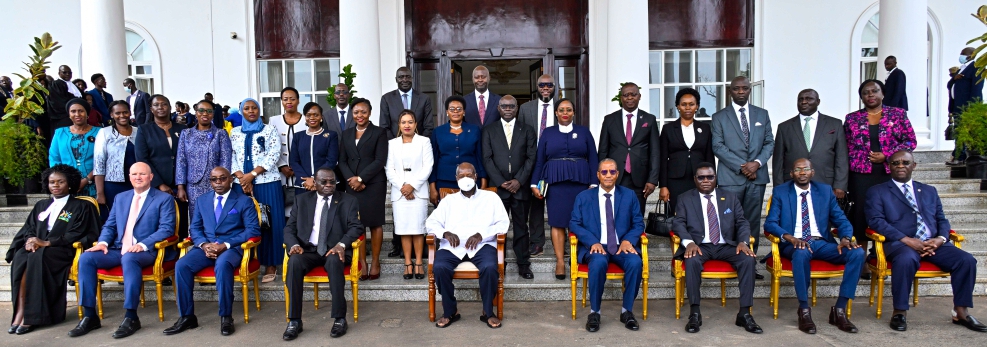
He made the call while presiding over the swearing-in ceremony of 21 recently appointed judges of the High Court at State House, Entebbe.

The judges sworn-in include; Hon. Justice Sarah Langa Siu , Hon. Justice Rosemary Bareebe Ngabirano, Hon. Justice Mary Babirye, Hon. Justice Lillian Alum Omara, Hon. Justice Charles Kasibayo, Hon. Justice Mary Kaitesi Kisakye, Hon. Justice Susan Odongo, Hon. Justice Karooli Lwanga Ssemogerere, Hon. Justice Joanita Gertrude Bushara, Hon. Justice Simon Peter Kinobe Mutegeki, Hon. Justice Vincent Opyene, Hon. Justice Sarah Birungi Kalibbala, Hon. Justice Isaac Teko Bony, Hon. Justice Deepa Verma, Hon. Justice Flavia Grace Lamuno, Hon. Justice Fatuma Nanziri Bwanika, Hon. Justice Kwemara Kafuuzi Gelase, Hon. Justice Godfrey Himbaza, Hon. Justice Andrew Khaukha, Hon. Justice Dr. Ginamia Melody Ngwatu and Hon. Justice Ida Nakiganda.
Speaking to the men and women of the wig, Museveni proposed renaming ADR to “Original Dispute Resolution,” arguing that traditional systems of resolving conflicts have long existed in African cultures and should be embraced alongside formal legal processes.
“According to our original dispute resolution, like in Banyankole tradition, if a woman was unhappy in her marriage, she would return to her parents, and both families would sit down and have a roundtable discussion. Whoever was found wrong, be it the husband or wife would pay some sort of compensation, except in serious cases like murder,” he said.
He thus reiterated his call to expand ADR to every corner of Uganda, emphasizing the need for fast, fair, and affordable dispute resolution.
The President stressed that local tribunals should be empowered to handle minor cases, reducing the burden on formal courts and ensuring that justice is delivered swiftly.
“We need to take ADR down to the villages, Let the local tribunals handle cases like stolen goats or family disputes. It’s cheaper, quicker, and rooted in our culture,” he said.
The President expressed satisfaction that ADR was finally gaining recognition but challenged judicial officers to make it more accessible to ordinary citizens.
“Why can’t you sit down and listen instead of standing here and there with arguments of objection and ‘My Lord’? This system you are using is very expensive. We need to downgrade ADR to the villages. Remove magistrates from handling village cases and use local tribunals. If someone steals a goat, they can replace it immediately instead of dragging the case through costly legal procedures,” he said.
Museveni underscored the effectiveness of ADR by drawing from biblical history, referencing the famous story of King Solomon.
“Even King Solomon used this system about 4,000 years ago. When two women came to him claiming to be the mother of a living child, Solomon ordered the baby to be cut in half. The real mother pleaded to spare the child’s life, and the other agreed to the proposal. Solomon then gave the child to the true mother. That was fast, fair, and effective dispute resolution,” he narrated.

The President urged the judiciary to prioritize justice for the common person, emphasizing three key principles that should guide the justice system: calmness (obuteka), justice (obulinganiza), and economic strength (enkubito).
On calmness, President Museveni stressed that the primary goal of any justice system should be to maintain peace and calmness in society. He explained that when justice is delayed or denied, it creates anger and unrest, undermining social harmony.
“Justice should ensure calmness in the country. No one should feel angry because of failure to get justice,” he said. He pointed out the dangers of releasing criminals back into the community through police bonds and judicial bails, especially those who steal resources meant to uplift vulnerable populations.
“In villages, we give people pigs, chickens, and other support under government programs, but when thieves steal these, the police give them bonds, and the courts give them bail. This discredits the justice system at the grassroots level,” Museveni noted.
He called for a justice system that resolves disputes quickly and fairly, preventing unnecessary tension and frustration among the people.
The President emphasized that justice must focus on equality and fairness, ensuring that those who have been wronged receive redress.
According to him, the judicial system should be driven by the need to protect the rights of victims and hold offenders accountable without bias or unnecessary delay.
“Justice means ensuring there is fairness for the one who is wronged,” he said.
He urged judicial officers to recognize that justice is not just about legal procedures but about achieving real solutions for the people.
The President warned against practices that prioritize legal formalities over substantive justice, reiterating that ordinary Ugandans need quick, clear resolutions to their disputes, not prolonged legal battles.