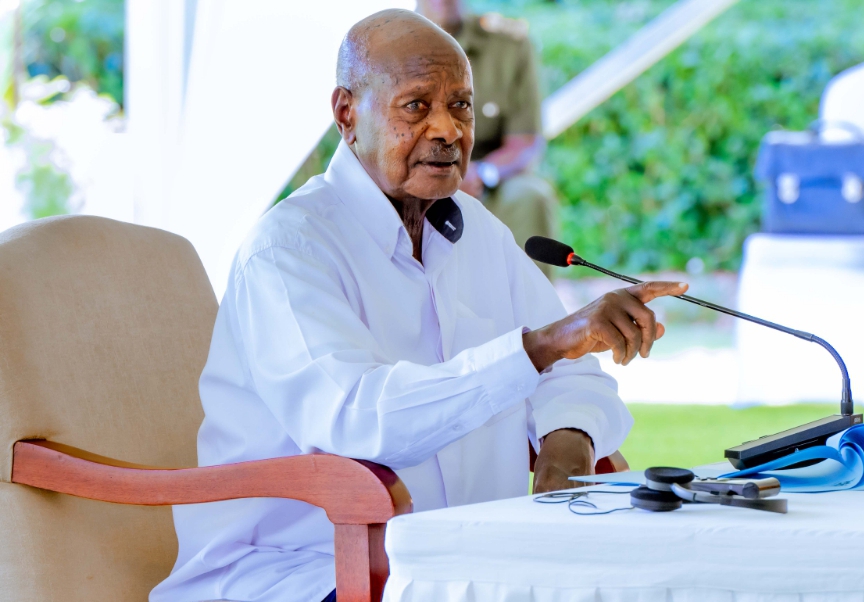
President Yoweri Kaguta Museveni has reiterated the urgent need for African solidarity and increased financial support to Somalia, as a key pillar for sustainable peace and stability in the Horn of Africa.
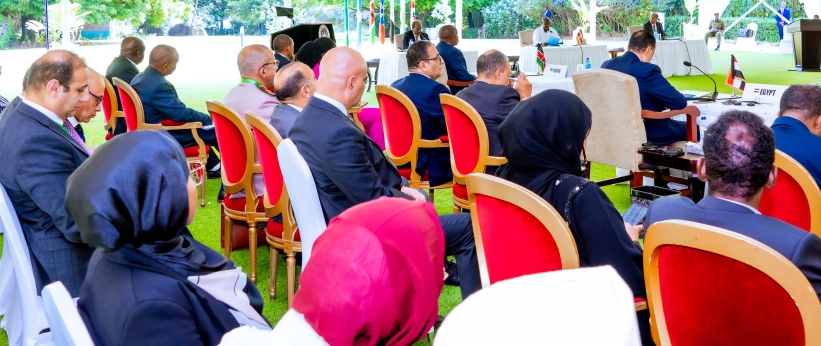
The President made the remarks while chairing the Extraordinary Summit of Troop-Contributing Countries (TCCs) to the African Union Support and Stabilization Mission in Somalia (AUSSOM) at State House, Entebbe.

The high-level summit brought together leaders and representatives from across the African continent to deliberate on the future of Somalia’s security, the transition of the African Union peace mission, and the broader regional efforts to counter terrorism and restore stability.
“We need to assist Somalia to get out of these problems. As you have heard, more money is needed to sustain the stabilization mission,” President Museveni said, urging African states and partners to do more to support Somalia’s peace building efforts.
Reflecting on Africa’s own struggles with dictatorship and instability, President Museveni invoked the spirit of Pan-African solidarity that once aided Uganda during the fight against Idi Amin. “It is solidarity which helped Africa come to where we are today. When we had a problem with Idi Amin, we were supported by our brothers from Tanzania and Mozambique,” he said.
President Museveni further delved deep into the ideological foundations of Uganda’s post-conflict recovery, development and national unity.
He emphasized the four guiding principles of the National Resistance Movement (NRM): Patriotism, Pan-Africanism, Socio-Economic Transformation, and Democracy.
He cautioned against the politics of identity, sectarianism, and clan divisions, warning that these were dangerous distractions that could derail Africa’s progress.
“If I was to play the politics of identity as a Munyankore, I would first be an enemy of the Banyankore before becoming an enemy of Uganda,” President Museveni said, stressing that prosperity in Uganda depends on mutual interdependence among its diverse communities.
He also outlined Uganda’s journey from a failed state between 1966 and 1986 marked by the collapse of state institutions to a stable and functional state anchored on ideological clarity and a people-centered governance model.
Museveni argued that the same formula could be adopted in Somalia and other African countries facing prolonged insecurity.
Commenting on Somalia’s challenges, President Museveni criticized the underfunding of the Somali National Army and the African Union mission, describing it as an “underdose” that had prolonged the country’s instability.

“Al-Shabaab is a weak force. If they had a healthy cause and support, they would have overrun Somalia by now. What has prolonged their existence is the small, under-supported Somali army and external forces,” he said.
He proposed the formation of a volunteer-based national army in Somalia, inspired by Uganda’s experience during its liberation struggle.
President Museveni recounted how Uganda, with the support of Tanzania and Mozambique, raised an effective force of 9,000 troops from a core of just 28 trained cadres, between December 1978 and April 1979, without the luxury of salaries.
He stressed that victory came from ideological clarity, volunteerism, and commitment to a just cause not merely from funding.
“Somalia and its supporters must stop the under-dosing. We need enough, well-trained and well-equipped Somali soldiers or enough, properly equipped external forces. With adequate funding, Uganda is ready to contribute more troops,” he said.