President Yoweri Kaguta Museveni has called on leaders to address persistent bottlenecks undermining government service delivery and social transformation.
These bottlenecks according to him include; sabotage of free education and healthcare system, corruption and land grabbing.

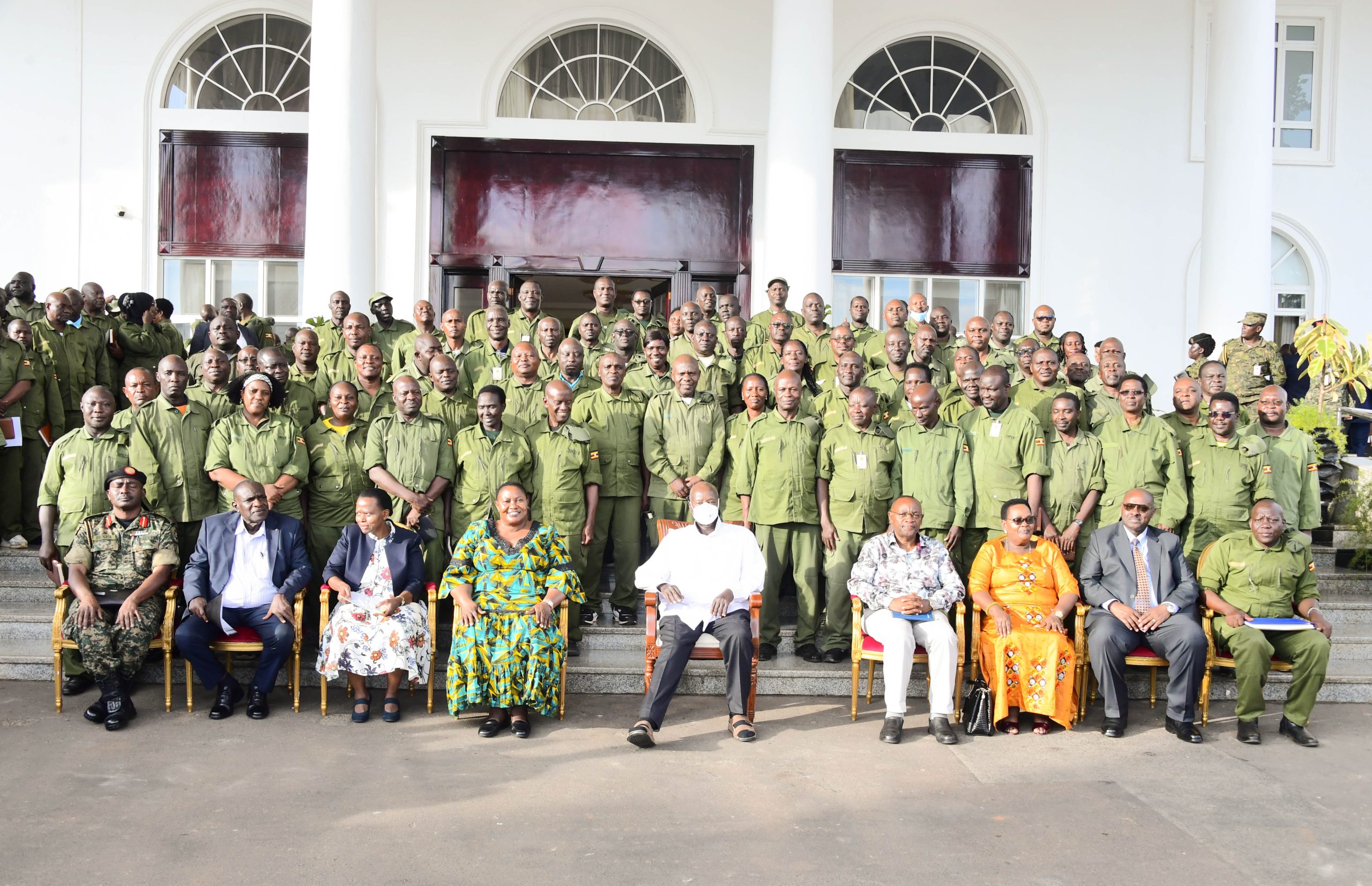
The President made the remarks yesterday while meeting about 200 Chief Administrative Officers (CAOs), Town Clerks and Under Secretaries at State House, Entebbe.
The government administrators recently completed a training course at the National Leadership Institute (NALI) in Kyankwanzi.
The training, held under the theme: “Transformative Public Service: A Path to Development, Improved Service Delivery and Wealth Creation”, was aimed at equipping civil servants with ideological clarity and practical tools for national transformation.
During his address, the President identified a number of ‘irritants’ he said were eroding public trust in government. Among these was the illegal practice of charging learners in government-aided schools, which he described as a betrayal of the Universal Primary and Secondary Education (UPE and USE) policy.
“Why has the political class failed to see the importance of Boona Basome (Education for All)?” the President asked. “We have seen numbers dropping from primary seven to Secondary. The head teachers are sabotaging our free education program by imposing illegal charges on parents.”
President Museveni also urged CAOs and town clerks to enforce the no-fees policy in public schools and cautioned against the expansion of boarding schools under the guise of public education.
“We don’t need boarding schools in order to provide free education. Let the children sleep at home. These added costs are suffocating poor families,” he noted.
Turning to healthcare, President Museveni decried the persistent theft of drugs in government health centres, even as immunization efforts continue to succeed in eliminating diseases like measles and polio.
“The stealing of drugs is a big irritant. We must stop it. Immunization is working and we have proof some diseases have disappeared. But corruption in our health facilities continues to cause suffering,” he noted.
The President also spoke out strongly against land grabbing, particularly when facilitated by rogue elements within the security forces.

He pledged to issue an Executive Order banning soldiers from involving themselves in land disputes.
“The army’s duty is to protect Uganda’s borders, not to patrol land boundaries,” he said.
Museveni emphasized that eliminating these service delivery irritants would restore public confidence in government and accelerate national development.
On the subject of wealth creation, the President revisited the NRM’s 1996 Four-Acre Model strategy, which advocates for intensive agriculture on small landholdings. He described the model developed after a careful study of local and international market demands as the medicine for families with fragmented land holdings.
“In our strategy, one acre should be for clonal coffee, one for fruits like mangoes or oranges, one for pasture for zero-grazing dairy cows, and one for food crops like bananas and cassava,” he said.
“In the backyard, families should rear poultry, pigs, and even engage in fish farming near wetlands. These seven activities can transform the livelihoods of smallholder farmers.”
President Museveni also contrasted this with extensive agriculture, such as tea, cotton, tobacco, and sugarcane farming, which he said only generates significant income if done on a large scale.
The President concluded by urging public servants to serve with integrity and commitment to the broader vision of socio-economic transformation.
“If you work only for the stomach and forget the pocket, you’ll remain poor. But if we combine free education, health, and wealth creation, Uganda will rise,” he said.