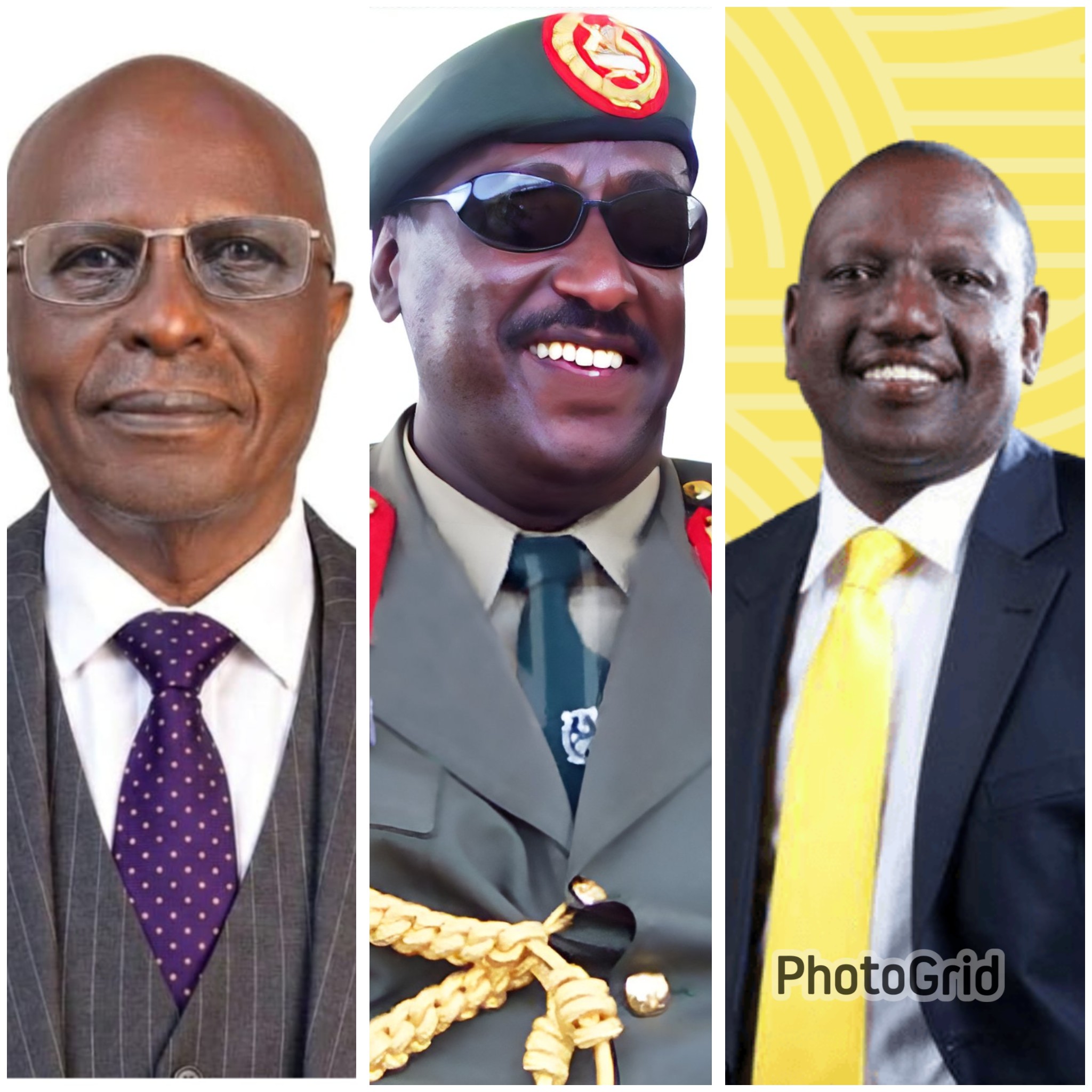
BY BARRISTER PETER MAGOMU MASHATE
Gen. Salim Saleh’s reported proposal of a government of national unity is an undeniably BIG STEP and a timely intervention in our national reconciliation.

To me, this framework appears entirely consistent with His Excellency President Yoweri Kaguta Museveni’s historical principles of de-escalation, forgiveness, and national cohesion.
However, for me as a legal scholar and practitioner, I most respectfully submit that we put Gen. Saleh’s ground-breaking proposal into the stark context of Uganda’s constitutional developments and bottlenecks since independence.
If we do not, we are doomed to repeat a vicious, historic cycle.
The core vulnerability of early post-colonial African states was a failure to acknowledge a fundamental truth: “That rules in isolation cannot create a nation; rather, a nation must first collectively agree on its rules”.
The Ghost of Top-Down Engineering discloses that
the primary lesson of both the 1962 Westminster model and the 1970 “1+3” ideological experiment of Dr Milton Obote was that elite-driven, top-down constitutional design fails without an organic grassroots consensus.
Unfortunately, subsequent history shows this lesson was largely ignored.
The 1962 model was negotiated in the distant boardrooms of Lancaster House, while the 1970 model was decreed by executive mandate during a state of emergency.
When institutions fail to provide peaceful, predictable avenues for the transfer of power or the management of tribal friction, politics inevitably reverts to raw force, as manifested by the Idi Amin coup of 1971. Idi Amin did not destroy a functioning democracy; he stepped into the structural wreckage of an electoral architecture that had already collapsed under the weight of its own internal contradictions.
The 1995 Constitution was born out of an extensive, years-long consultative process meant to address these failures, initially building a deep national consensus.

However, the subsequent removal of presidential term limits (2005) and age limits (2017) demonstrated that our framework remains vulnerable to elite manipulation from the top down. While I contend these modern amendments were necessary in exceptional circumstances for continuity and national cohesion, they reflect a familiar, worrying pattern.
From Tribal Alliances to Commercialised Coercion.
In evaluating the 1970 system, I have long warned that cross-regional campaigning without deep reform would favor wealthy elites, substituting ethnic clientelism with state-sponsored clientelism. This has manifested explicitly in modern Ugandan politics.
Modern elections are no longer just fought along rigid, overt tribal lines like the old UPC-KY alliance; instead, they are heavily mediated by financial patronage. The state machinery and immense financial capital are deployed to secure multi-ethnic coalitions.
Furthermore, running a viable parliamentary campaign across even a single district today requires immense wealth, mirroring the logistical barriers of the historical “1+3” system. The result is an elite capture of our democratic space, where access to state resources or private capital dictates political survival.
The Failure to Move Past Majoritarianism
Despite the historical lesson that the First-Past-The-Post (FPTP) system exacerbates existential, zero-sum dynamics in a fractured society, Uganda has stubbornly clung to it.
Elections in our multi-party era continue to feel like existential threats to the losing sides. Because representation is not proportional, entire regions or demographic blocks feel systematically marginalized the moment their preferred candidates lose.
Additionally, the continuous creation of new districts has fragmented the electorate further, keeping politics highly localized and dependent on central patronage for service delivery, rather than fostering a cohesive national policy debate.
The “Tutelary Politics” Rebrand
Obote’s 1970 assumption that the state needed to “discipline” the masses found a successor in the early years of the National Resistance Movement (NRM). To the NRM’s credit, unlike Obote, it organized the masses through participatory democracy from the village level (LC1). However, the underlying paternalism remained.
For nearly two decades, the NRM implemented the “Movement System,” which suspended political parties under the guise of preventing sectarianism.
While this successfully managed overt ethnic violence for a time, it operated on the same principle as the “1+3” system: that the population was not yet mature enough for unregulated multi-party democracy.
When multi-party politics was finally reintroduced in 2005, it immediately inherited the old structural fractures.
Suppressing political expression does not cure underlying social divisions.
Lessons from the Region
When we look across the East African Community, history teaches us that top-down elite accommodations regularly collapse if the underlying electoral system remains a winner-take-all scramble.
Consider the Kenyan Precedent of the 2008 National Accord.
Following the 2007 post-election violence, Kenya established a Grand Coalition Government, sharing power between a President and a Prime Minister. While it successfully halted immediate bloodshed, it operated as an uneasy marriage of convenience.
Its submitted that this was because the underlying legislative structure remained deeply rooted in localized FPTP rivalries, ethnic polarization simply simmered beneath the surface until the coalition dissolved.
Similarly, look at the Zimbabwe Dilemma of the 2009 Government of National Unity (GNU). The arrangement brought the opposition into the executive cabinet. However, because the ruling party maintained structural control over the state apparatus, the arrangement ultimately resulted in executive capture. The opposition was effectively swallowed by the state.
These continental examples prove my core legal diagnosis: fixing the executive cabinet while leaving a polarizing legislative election system intact is akin to painting a building with a fractured foundation.
The Ultimate Tragedy
The ultimate tragedy of Uganda’s electoral trajectory is that we have continually mistaken the manipulation of rules for the building of a state.
The 1962 framework collapsed because it ignored our deep fractures; the 1970 system collapsed because it tried to coerce unity from above.
Gen. Saleh’s proposal is indeed a big step, but it cannot stand alone. It is my considered submission that until Uganda undertakes a genuine, bottom-up renegotiation of its national contract—one that prioritizes proportional inclusion and deep electoral reform over winner-take-all dominance—our electoral architecture will remain an elaborate stage built over an active fault line.
*The writer is an Administrative, Constitutional & Human Rights Barrister-at-Law, United Kingdom/ former Private lawyer to H.E President Museveni.
NB: These are personal views and not necessarily those of the publisher-Editor.