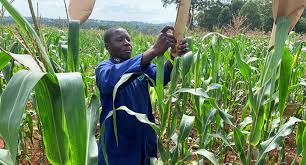
KAMPALA — As Uganda marks the 40th NRM Liberation Day, new agricultural performance figures are reinforcing a growing national sense of optimism, with the sector now standing as one of the clearest symbols of the country’s economic transformation over the past four decades.
According to the Ministry of Agriculture, Animal Industry and Fisheries, Uganda has begun 2026 with record agricultural export earnings, stronger productivity, and rising household incomes — a sharp contrast to the instability and production constraints that characterized much of the period before 1986.

Maj. Gen. David Kasura-Kyomukama, the Ministry’s Permanent Secretary, said agricultural exports have surged from USD 1.661 billion in FY 2020/21 to USD 4.175 billion in FY 2024/25, now accounting for 38.49 percent of Uganda’s total exports. He added that the sector contributed 26.1 percent to GDP and registered 6.6 percent growth in the last financial year alone.
“These results reflect decades of deliberate effort to stabilise the country, rebuild institutions and invest in production,” Kasura said, noting that agriculture today is not only a source of food security but also a pillar of export growth, industrialisation and job creation.
About 70 percent of Ugandan households — 7.12 million out of 10.8 million — are engaged in agriculture, making the sector central to national livelihoods. Over the last several years, government strategy has focused on raising productivity through research, improved genetics, mechanisation, irrigation, pest and disease control, value addition and better market access.
Kasura said these investments are helping shift farming from subsistence to commercial production, enabling more families to earn stable incomes and participate in national growth. He added that 73 percent of the Ministry’s 2021 manifesto targets have already been achieved, with others underway.
As the country commemorates four decades since the liberation struggle ushered in relative peace and policy continuity, many rural communities are now seeing tangible results in expanded irrigation schemes, improved access to farm machinery, stronger disease control systems and widening export markets.
For many Ugandans, the progress in agriculture — a sector that employs the majority of the population — is viewed as proof that long-term stability and sustained public investment can transform livelihoods. With fresh commitments aimed at deepening agro-industrialisation between 2026 and 2031, the sector is increasingly seen not just as Uganda’s backbone, but as a pathway to middle-income status.