By Sadique Bamwita
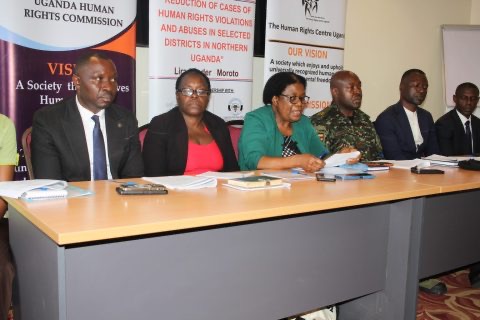
The Human Rights Centre Uganda (HRCU), Uganda Human Rights Commission, African Centre for Treatment and Rehabilitation of Torture Victims (ACTV), duty bearers from Access to Justice and Security sectors and Human Rights Defenders in Civil Society have met and discussed some of the key emerging human rights issues and concerns in Uganda.

The Executive Director Human Rights Center Uganda , Margaret Sekaggya noted that as the 2026 general elections come closer, the environment for the enjoyment of human rights is being shaped by shifts in law, policy, institutional behavior, and citizen–state relations.
She says though several areas continue to raise significant concern, it is equally important to acknowledge the positive developments that have strengthened the protection of rights and opened new avenues for dialogue, accountability, and reform.
“Many of us might recall and be aware that a number of efforts have been put in place to promote, protect and realize human rights and fundamental freedoms for all persons in Uganda” she said.
She went on:
‘Through continued engagement of the authorities and some civil society actors, Uganda was delisted from the Financial Action Task Force (FATF) Grey List meaning that Uganda as a country was removed from the FATF grey list. This eases compliance pressures, restores donor confidence, and strengthens CSO operations across the country’.
In relation to freedom of assembly during political gatherings Sekajja observed that there has been a noticeable shift in the conduct of security agencies, with a relative reduction in the violent dispersal of political rallies and public assemblies compared to previous election periods.
On regard to sustained Funding and Support to Civil Society, Sekaggya explained that despite global pressures on civic space, Uganda continues to attract substantial development and human rights funding.
On the issue of Right to fair hearing she noted that :
“There are several progressive Judicial decisions that continue to reaffirm and uphold constitutionalism and rule of law. The Constitutional Court for instance nullified Section 25 of the Computer Misuse Amendment Act which made it an offence for a person to “wilfully and repeatedly use electronic communication to disturb or attempt to disturb the peace, quiet or right of privacy of any person with no purpose of legitimate communication.
” On 31st January 2025, the Supreme Court delivered a landmark ruling on civilians and ordered officials to halt all ongoing military trials of civilians and transfer them to the country’s civilian court system, ” Ms.Sekagya appreciated the court decision.

On the issue of strengthened Action and Responsiveness from National Human Rights Institutions (NHRIs), Sekaggya highlighted:
“There is greater visibility and responsiveness of NHRIs particularly the Uganda Human Rights Commission (UHRC) and Equal Opportunities Commission (EOC), in calling out violations and holding duty bearers to account. For instance, UHRC investigated 727 complaints in 2024. Out of the 727 complaints investigated, 307 (42%) complaints were investigated to conclusion, while 420 (58%) were partially investigated.
Sekagya added that;
‘The UHRC’s backlog at the investigations level reduced by 66% from 803 in 2023 to 529 in 2024. These developments and many others demonstrate that, even within a politically charged environment, institutional resilience, judicial oversight, and civic engagement remain alive and active, providing critical checks and avenues for redress.
She says despite the positive developments, as human Rights defenders, they still grapple with some key human rights issues and concerns including but not limited to:
‘Freedom of Assembly and Expression: The improper implementation of the Public Order Management Act (POMA) has significantly hampered lawful activities, as evidenced by several incidents. For example, peaceful protests, whether led by opposition parties, student groups, or civil society actors, are often met with disproportionate force, arbitrary arrests and pre-emptive detention of organizers.
She continued:
“Despite constitutional guarantees under Article 29 of the 1995 Constitution, the authorities have routinely deployed legal instruments, security forces, and administrative measures to curtail public dissent and limit civic participation.
‘Access to Information and Unequal Access to Media Platforms: On 28 October 2025, some journalists were barred from covering sessions of the Parliament of Uganda yet they had previously held accreditation but only to be turned away without a formal explanation. This was in addition to earlier restrictions under which the same journalists had been blocked from covering presidential activities since March 2025.
The exclusion has major implications for democratic accountability and the public’s right to information.
Ms.Sekaggya further noted: “During the recently concluded Kawempe North Bye-Elections in March 2025, journalists were brutalized and equipment confiscated. During the same period, a license belonging to Pearl FM was withdrawn over an alleged breach. The station was carrying out a live broadcast of what was going on in Kawempe. When you block journalists from covering events that are of public interest, you not only deny them the right to seek, receive and share information; you also threaten media freedom and the right to access information for members of the public.
‘As the 2026 general elections draw near, there are already fears that the same social media platforms are likely to be shut down. These concerns are likely informed by our recent history of internet shutdowns and censorship, which have become a recurring feature during pivotal political moments such as elections and protests. These actions by the state have created an
environment of skepticism and doubt regarding the government’s commitment to upholding internet freedom.
‘These violations illustrate the shrinking civic and press space in Uganda, undermining press freedom, self-censorship, and the public’s access to independent information. By extension, this state of affairs has also negatively affected the Constitutionally guaranteed right of access to information under article 41 of the 1995 Constitution.
Regarding abductions and illegal detentions she said:” The pattern/trend of abductions and illegal detentions of human rights defenders and activists reflects a worrying decline in respect for human rights and the rule of law in Uganda. These incidents, coupled with delayed judicial remedies and the involvement of security operatives, have deepened fears of state-sanctioned repression ahead of the 2026 general elections.
‘Unless urgent steps are taken to ensure accountability, uphold due process, and protect civil and political freedoms, Uganda risks further eroding public trust in democratic institutions and undermining its constitutional commitment to justice and human rights.
‘There has been evidence of enforced disappearances have resurfaced. During the 2021 election cycle, numerous citizens were abducted by security forces, often in unmarked vehicles commonly referred to as “drones,” and held incommunicado for days or weeks without trial.’
The Head of legal at the African center for treatment and rehabilitation of torture victims , Nancy Ayebare, said it’s the duty of everyone to make alarm about torture saying her agency strongly condemns acts of torture.
The Executive Director Human Rights Network for Journalists (HRNJ), Robert Sempala, expressed displeasure on the way security agencies have continued to attack and brutalize journalists during the ongoing campaigns.
The Head of Human Rights in UPDF, Maj.Gerald Muhumuza Bamwitirebye, acknowledged UPDF involvement in the ongoing elections saying as a revolutionary army that believes in people will continue to offer them security and peace throughout the election period.
The Director Human Rights in the Uganda police Force , Philip Mangeni, said as police they condemn violence adding that the force will continue to enforce the law without fear or favor.