
The issue of climate change continues to be a major stumbling block especially to the progress of Uganda’s agricultural sector. Available data indicates that if no adaptation measures are taken, the impact of costs of climate change to the country are estimated to come up to USD3.2-5.9bn per year.
Although Uganda has mostly a tropical climate characterized by stable rainfall patterns, the effects of climate change have turned around the seasons with the country experiencing shorter or longer rains and harsher droughts.

Often times, farmers in different parts of the country especially in eastern and north-eastern have experienced severe dry spells, floods and high temperatures and all these have badly impacted on their livestock and crops.
In addition to the severe weather patterns, farmers continue to face incidences of pests and diseases and yet 38% farmers are still involved in subsistence agriculture.
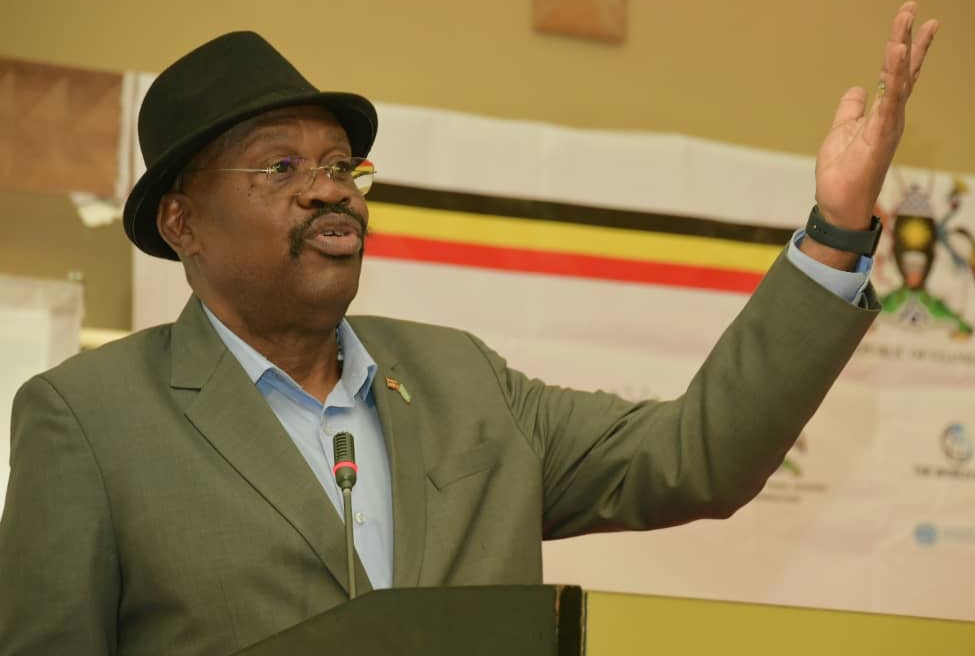
“I want to reiterate the Ministry’s commitment in fulfilling the shared goals and aspirations especially in getting our people into commercial agriculture” says Maj. Gen. David Kasura-Kyomukama, the Permanent Secretary Ministry of Agriculture, Animal Industry and Fisheries adding that the ministry is undertaking various government interventions and projects to achieve the goal of agricultural transformation.
One such projects is baptized as Uganda Climate-Smart Agricultural Transformation Project (UCSATP).
Under the able stewardship of Commissioner Eng. Boniface Okanya, this is a 6-year project implemented by the Ministry and its agencies including National Agricultural Research Organization (NARO); the National Animal Genetics Resources Centre and Data Bank (NAGRC &DB) and Uganda National Metereological Authority (UNMA). Eng. Boniface Okanya the brain behind this project is the Ministry’s commissioner Agricultural Infrastructure, Mechanization and Water for Agricultural Production.
“This is one of the unique projects we shall be implementing as a Ministry. It is the only project bringing together all the Ministry departments and agencies working together. We have investments in crop, Livestock and Fisheries” Says Gen. Kasura but however, notes that the success of every project depends on fulfillment of the role played by the district in the implementation of the project especially the Technical teams, accounting officers and the Monitoring teams.
This project billed at USD354.7m aims to increase productivity, market access and resilience of select value chains in the project area and to respond promptly and effectively to an eligible crisis or emergency.
The same project according to Gen. Kasura will support the government to identify, develop, and incentivize adoption of climate smart agriculture technologies and management practices that contribute to climate adaptation of agricultural value chains.
“This is meant to sustainably increase productivity and household incomes while enhancing resilience to climatic shocks” the battle-hardened Gen. Kasura explains!
He says the financing to this silver bullet project to counter climate change effects on agriculture, involves a USD325 million Credit from the International Development Association of the World Bank and USD25 million Grant from the Window for Host Communities (WHR) and USD4.7 million counterpart funding from the government of Uganda.

According to the plan, this project is expected to directly benefit about 760,000 households or (3,900,000 individuals), and indirectly benefit approximately 1,900,000 households or (9,500,000 individuals) in 69 target districts.
Among these, beneficiaries from the non-refugee districts will be about 620,000 households and 60,000 refugee households while are 80,000 refugee-hosting households, representing 65% of the total population in the project districts.
Gen. Kasura however, expressed fear about possible delays in timely implementation of the project citing factors such as availability of land as one that might affect it.
“One of the biggest constraints to public investments is availability of land. We have had projects delay or cancelled because of land compensations. We have had scenarios where districts agree to offer land and when it comes to actual implementation, then they begin to ask for compensation” he noted emphasizing that this project too; has a number of investments which will require land.
He cited some of them as investments in water for agricultural production, Fisheries and Aquaculture, Mechanization among others which shall all will require land.
“I want to emphatically state that we shall not be compensating for land acquisition. We shall not put any investment in the district unless we verify that the land is available for the investments. This goes to also our technical staff to take note” Gen. Kasura warned in advance.
He said this project will also ensure that some of the underutilized public investment facilities such as those set up under Agricultural Cluster Development Project are properly utilized.
“We need to have a clear strategy to make these facilities operate. Under livestock and fisheries, there will be demand for feed, so the farmers growing maize will strongly benefit from these” he explained and also urged the masses to own these projects instead of referring to them as ‘government projects’
“During some of the visits I have made on these investments, I have been shocked to listen to district people making statements like ‘your project’ including farmers and farmer groups. These investments are for you to benefit the local person” he explained.

ABOUT THIS PROJECTS
The project comprises five interlinked components including; Strengthening Climate-Smart Agricultural Research, Seed and Agro-Climatic Information Systems worth US$66.9 million, of which US$64.6 million is from IDA and US$2.3 million – WHR). This component will support the development, validation, packaging, and dissemination of context-specific climate smart technologies and practices to target beneficiaries. The component will strengthen technical and institutional capacity to deliver technologies, support the development of the seed delivery systems, and provide agro-meteorological information services. It will facilitate investments in climate resilient seed production and marketing systems.
Another component is Promoting Adoption of Climate-Smart Agriculture Technologies and Practices to cost US$204.5 million, of which US$172 million is from IDA and US$32.5 million – WHR). The component will among others support investments for upscaling and adoption of climate smart technologies and practices GHG mitigation, agricultural productivity, and incomes in project areas. It will also support Construction and equipping of the mechanization centres to increase uptake of agricultural mechanization and labor-saving technologies in addition to providing Irrigation and Water for Agricultural Production, Animal disease control and Special interventions in Fisheries and Aquaculture.
The third component is Market Development and Linkages for Selected Value Chains worth US$57.3 million of which US$44 million – IDA; US$13.3 million – WHR); The component aims to improve access to remunerative markets through increased access to climate smart harvesting, post harvest handling, storage, value addition, market linkage services, equipment, and infrastructure. The Key investments in this component include rehabilitation of farm to market access roads/choke points, purchase of cold chain and value addition equipment
The other component is that of Contingency Emergency Response Component. This zero-cost component will finance eligible expenditures under the Immediate Response Mechanism in case of natural or man-made crises or disasters such as severe droughts, floods, specific pests and disease outbreaks, and severe economic shocks in Uganda
The last component is Project Management, Coordination, and Implementation to cost US$21.3 million of which US$19.4 million is from IDA and US$1.9 million WHR. The component will support the management, monitoring, and evaluation of the project. It will strengthen the planning and coordination of activities supported by the project, as well as the monitoring of their implementation, financial management (FM) processes, program communication, and knowledge management.
The project will be implemented in target 69 districts across 13 agro-ecological zones of the country, including 7 refugee hosting districts.