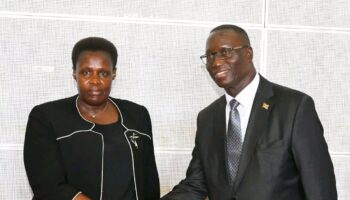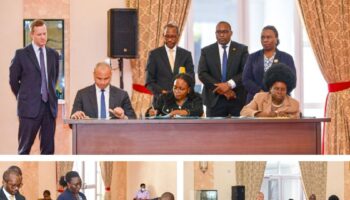

The Financial Intelligence Authority-FIA, Uganda’s Anti-Money Laundering watchdog has; in conjunction with the tax body-URA, placed a Shs30m (plus) cap as money that must be declared to Uganda Revenue Authority before entering or exiting the country.
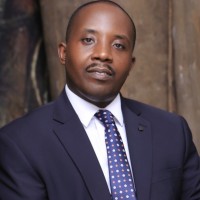
According to Bright Besigye, FIA’s Manager International Relations, as long as one has Shs30m or more, you must declare it to Uganda Revenue Authority for clearance.

He adds that FIA is aware that some unscrupulous individuals might choose to convert their money into other valuables like precious stones in order to avoid detection, but even these, they must declare such valuables to URA before being allowed to enter or leave the country.
He said this is part of the campaign to stop money laundering, financing of Terrorism and Financing of proliferation of weapons of mass destruction.
“The challenge (we still face) is in implementation but we’re working out a strategy with URA to ensure that anyone entering or exiting Uganda should declare. We’re not stopping you from bringing money but we want to know the source and purpose” he said during a FIA-MEDIA engagement workshop at Imperial Royale hotel-Kampala.
This initiative by FIA means politicians intending to carry out fundraising abroad, real estate dealers, casino fans among others known for carrying large amounts of money as they enter or exit the country will have to explain in detail why they carry such large amounts of cash before being allowed to proceed.
On February 23 2024 during it’s conference in Paris, the Financial Action Task Force (FATF), a global money laundering and financing terrorist watchdog removed Uganda alongside three others including Barbados, Gibraltar and UAE from the grey list. FATF sets international standards that aim to prevent those illegal activities and the menace they cause to society.
ABOUT FATF’S GREY LIST
A grey list is a list of shame on which countries considered not having strong laws and regulations to curb the flow of dirty money otherwise refered to as money laundering are placed.
Money Laundering according to Phiona Nabaggala, FIA’s Manager Training and Outreach, refers to conversion of legal money into illegal money.
“It’s an act by which the proceeds of crime are made to appear legitimate” she explained, adding that for example those involved in terrorism Financing go through four stages including raising of funds, moving those funds, storing them and finally use those funds.
With Uganda currently being struck off the infamous grey list, Besigye said that this brings more work for Uganda to ensure that it retains it’s positive Anti-Money Laundering standards.

For a country to be classified as a higher risk country, Besigye said such countries have defficiencies in dealing with money laundering and terrorism Financing.
Such a classification therefore means that such a country is put under increased scrutiny by the FATF with the country expected to make critical changes to it’s financial infrastructure to reduce the risk of being a haven for money launderers.
In the region according to Besigye, Uganda is now surrounded by High Risk countries including Kenya, Tanzania, DR Congo and South Sudan. Others are Nigeria, Mozambique, Burkina Faso, Mali, Senegal and Cameroon.
A country like Kenya is therefore, subjected to stricter due diligence when it’s dealing with the rest of the world and it might affect the country’s ability to access international funding or attract meaningful investors.
“All countries surrounding us are considered high risk. What we have done is to tell our banks to apply enhanced due diligence. There are measures you should apply on transactions originating or destined for those countries” Besigye said in light of Kenya, Tanzania, DR Congo and South Sudan being on the FATF grey list yet Uganda was cleared by FATF. He was presenting a paper on Uganda’s Post-Grey List Strategy.