
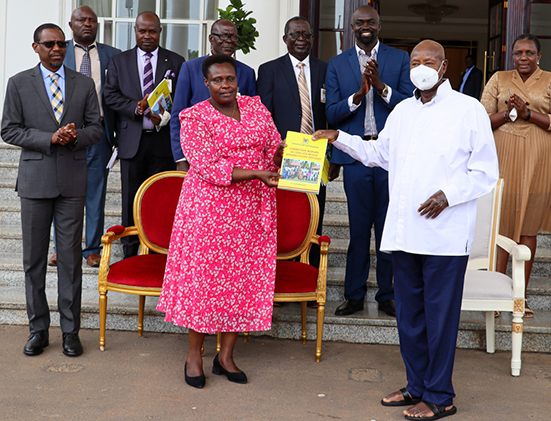
President Yoweri Kaguta Museveni has endorsed recommendations from a consultation report on cattle compensation in the Teso sub-region, describing them as realistic, inclusive, and transformative.
The President made the remarks yesterday at State House Entebbe during a meeting with a select committee led by the Vice President, H.E Jessica Alupo.

The committee included Members of Parliament, cultural leaders, and religious figures who had consulted widely across Teso following concerns about corruption and inefficiency in the ongoing cattle compensation program.
“I’m very happy with the substance of the report because it’s more realistic, all-inclusive, and transformative,” President Museveni said.
He went on “The other format was wasting a lot of resources and excluding many people. We shall discuss this report in cabinet and also listen to what the people of Lango and Acholi are saying.”
The delegation to the State House included His Highness Emorimor Paul Sande Emolot, the cultural leader of Iteso, and the Kumam cultural leader, Won Ateker Papa Kumam Raphael Otaya.
Usuk County MP Okiror Bosco presented the report on behalf of the consultation team.
The consultations affirmed President Museveni’s proposal for a uniform restocking plan of five cows per household in Teso.
The sub-region comprises 12 districts with an estimated 489,000 households, according to the 2024 National population and housing census.
“Across the region, they have looked at five cows per household. Another proposal was to consider compensation in the cash equivalent of the five cows to be managed at the sub-county level, so households can purchase for themselves,” Okiror explained.
He noted that the price of a good female cow ranges between UGX 1.5 million and UGX 2 million.
President Museveni backed the plan and also acknowledged the potential challenges with polygamous households.
“For me, I would be comfortable with each male-headed unit, whether polygamous or not, first getting their share. Once the cows multiply, those families will be agents of change, and the cows can then be shared. The question is affordability—five cows per family in installments, and then we can look at the extended families,” the President said.
He also clarified that the districts of Butebo and Pallisa, which had petitioned to be included in the scheme, would be considered separately.
During the meeting, President Museveni also addressed grievances from Teso residents regarding the presence of Balaalo herders in their area.
“They should go. I solved this problem long ago. They have no good reason to stay in those areas illegally. If they were to move legally, it would be easy after acquiring the necessary procedures and ensuring the safety of their animals and the community to live in harmony,” he said.
Meanwhile, H.E Alupo told the President that the consultations were conducted comprehensively and without incident. She commended the contribution of cultural leaders, whom she described as resourceful in shaping the final report.
“All the people of Teso unanimously supported the restocking program for every household in the region. Everybody was thanking you for appreciating that all people deserve to be empowered with a uniform formula,” H.E Alupo said.
She added that residents viewed the program not in isolation but as part of wider government efforts to lift Ugandans out of poverty.
The cultural leaders in attendance echoed her sentiments. Papa Emorimor Paul Sande and Papa Kumam Raphael Otaya expressed gratitude to President Museveni for involving traditional institutions in national development initiatives and pledged continued collaboration with the government to promote social and economic transformation.