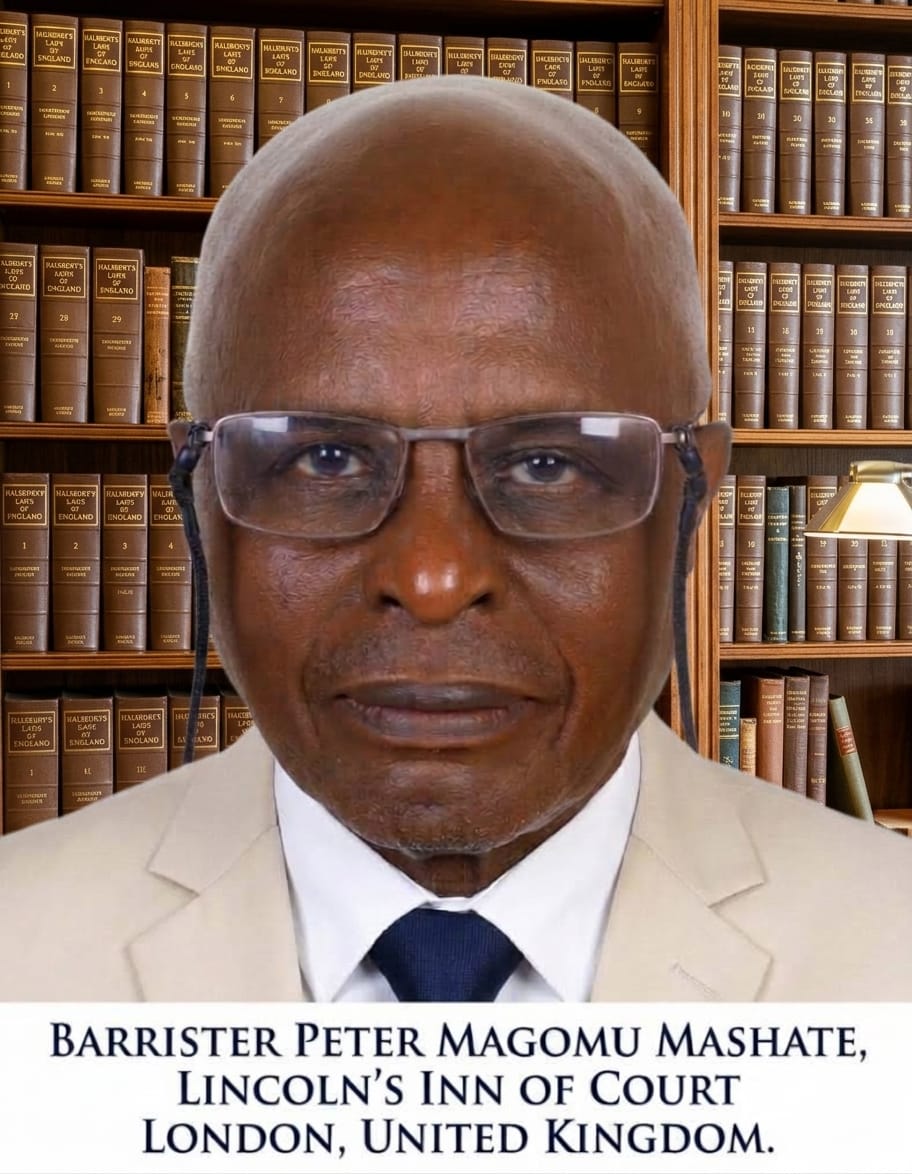
BY BARRISTER PETER MAGOMU MASHATE
Op-ed-When news broke that Cabinet had formally halted the proposed commercial redevelopment of Kampala’s Constitution Square, many Ugandans breathed a collective sigh of relief.

Yet, as a constitutional lawyer watching these events unfold from afar, my reaction goes beyond relief over a saved historic green space.
The sequence of events—a presidential letter directing the evaluation of a private hotel and mall project, public uproar, conflicting legal signals, and a subsequent Cabinet decision shelving the plan—offers a revealing case study into the health of constitutionalism, the separation of powers, and the rule of law under our 1995 Constitution.
To understand what just happened, we must look past the bricks and mortar of a proposed shopping complex and examine how state power is actually exercised in Uganda today.
First, this episode exposes the persistent friction between informal “directive governance” and formal constitutionalism.
Under Article 99 of the 1995 Constitution, executive authority is vested in the President, who is explicitly required to exercise that power in accordance with the Constitution and the laws of Uganda.
Administratively, there is nothing inherently unlawful about a President forwarding an investor’s proposal to a line minister for technical evaluation. However, in our political culture, a presidential letter rarely functions as a neutral inquiry. It carries immense political weight that often short-circuits statutory procedures, intimidates technical officers, and creates a presumption of approval before urban planners, environmentalists, or procurement bodies have even spoken.
True constitutionalism demands that power be channeled through established legal frameworks, not personal correspondence.
When private developers bypass the Kampala Capital City Authority (KCCA) and the Uganda Land Commission to seek direct executive blessing, they invert the legal order.
The fact that this proposal reached the threshold of public alarm before being stopped shows how vulnerable our administrative gatekeeping remains to top-down momentum.
Second, Cabinet’s decision to step back from the proposal offers a rare and instructive glimpse into the mechanics of collective executive responsibility and institutional checks.

Under Article 111 of the Constitution, Cabinet is not merely a ceremonial sounding board; it is the constitutional organ mandated to determine, formulate, and implement government policy.
By sitting down, weighing the legal, historical, and political realities, and resolving to preserve the square, Cabinet demonstrated that presidential directives are neither infallible nor absolute.
Equally significant was the broader ecosystem of separation of powers that forced this introspection.
While the judiciary did not have to issue an injunction this time, horizontal and vertical checks were visibly at work. Municipal leaders at KCCA, urban planning professionals, parliamentary oversight committees examining historical leases on the land, and an outspoken citizenry all exerted institutional pressure.
Even the visible contradiction within the executive—where senior legal voices initially defended the right to redevelop the land only for Cabinet to reverse course days later—underscores that statutory reality eventually outweighs political expediency.
*Where, then, does this leave the 1995 Constitution and the rule of law?*
On the surface, the rule of law prevailed. Constitution Square is no ordinary parcel of urban real estate. Named in honor of the promulgation of the 1995 Constitution itself, protected under frameworks stretching back to 1962, and housing the 1945 War Memorial under our monuments legislation, the square embodies the Public Trust Doctrine enshrined in Article 237(2)(b) of the Constitution.
That provision establishes that the government holds vital public spaces and ecological reserves in trust for the people of Uganda—not as private equity to be parceled out to commercial bidders. Cabinet’s retreat affirms that written constitutional and statutory protections still carry enforceable weight.
However, we must guard against complacency. A mature constitutional order should not require nationwide public outrage and a dramatic Cabinet U-turn to protect a gazetted national monument from unlawful alienation.
In a system governed strictly by the rule of law, a proposal to build a commercial mall on a protected constitutional landmark would be rejected quietly and routinely at the lowest administrative desk, simply because the law forbids it.
The lesson of Constitution Square is therefore twofold. It proves that our 1995 Constitution retains vital institutional pulse—that Cabinet deliberation, municipal pushback, and citizen vigilance can still check executive overreach.
At the same time, it reminds us that the rule of law in Uganda remains overly dependent on political vigilance rather than automatic institutional enforcement. Until we insulate our statutory agencies from the gravitational pull of executive letters, every public park, forest reserve, and historic square will remain only one directive away from its next existential test. Is it not?
THE WRITER IS AN ADMINISTRATIVE, CONSTITUTIONAL & HUMAN RIGHTS BARRISTER-AT-LAW- UNITED KINGDOM