
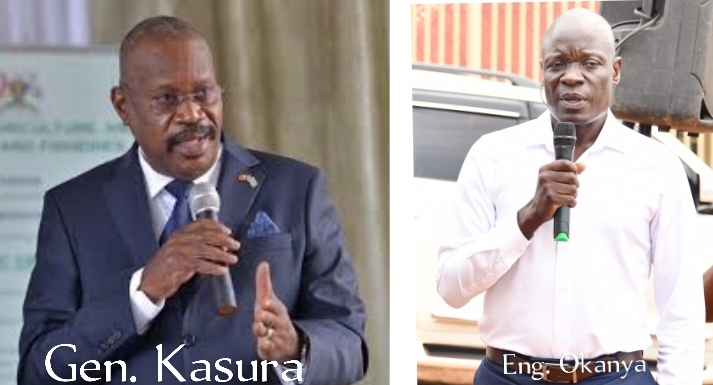
Maj. Gen. David Kasura-Kyomukama, the Permanent Secretary in the Ministry for Agriculture, Animal Industry and Fisheries [MAAIF], has observed the vital role of the Uganda Climate Smart Agricultural Transformation Project (UCSATP) in dealing with challenges affecting the agricultural sector in the country.
Some of the challenges he cited include climate change, watershed degradation and poverty. He says this multi-billion project aims to address such challenges by promoting climate-smart technologies and practices.

He therefore, urges all stakeholders to instill a sense of ownership of this project among communities and strengthening monitoring systems, with Resident District Commissioners playing a pivotal role.
“I urge district leaders, extension workers and communities to prioritize climate-smart initiatives and actively engage in the project to ensure its long-term success and sustainability” he said during the National Stakeholders Engagement workshop at Munyonyo.
He emphasized the project’s goal of transitioning agriculture from subsistence to a commercial and resilient sector aligned with Uganda’s Vision 2040.
In his speech, the battle-hardened General also emphasized the integral nature of project as it brings together stakeholders across fisheries, livestock, crops, and entomology to ensure a synergy.
The PS highlighted UCSATP’s focus on innovations in irrigation, mechanization, and post-harvest systems, underlining the project’s efficient and sustainable strategy to achieve agricultural growth.
Kasura-Kyomukama also outlined important issues which always affect the project’s success. These included delays in land acquisition, underutilization of previous investments, lack of ownership among beneficiaries, and weak accountability mechanisms.
He emphasized that investments would only proceed with verified land availability and that underperforming infrastructure from past projects would be optimized. The PS stressed the importance of district-level engagement to foster inclusivity, collaboration, and local ownership, urging district leaders, extension workers, and communities to prioritize climate-smart initiatives.
ABOUT UCSATP
UCSATP is a six-year initiative championed by this ministry with an aim of enhancing agricultural productivity, market access, and resilience to climate change impacts across 69 districts, including refugee-hosting communities.
In total, the project is being implemented in 69 districts under four value chain sub-sectors which include Crop, Livestock, Beneficial insects and Fisheries. The crop value chain is being implemented in 715 sub-counties wherein; coffee emerged as the leading commodity, followed by soybean and cocoa.

As for the Livestock Value Chain, 476 sub-counties, were selected prioritizing dairy (287) and beef (189) production while for Beneficial Insects, 717 sub-counties focused on apiculture and black soldier fly production were selected. The ministry also reports that on Fisheries, 162 sub-counties were designated for aquaculture and capture fisheries.
According to the UCSATP National Project Coordinator/Commissioner Eng. Boniface Okanya, the ministry held workshops in which a total of 8,147 stakeholders from the 69 targeted districts participated. Those who participated included politicians, technical staff and community members with the discussions centering on value chain selection, implementation strategies and stakeholder roles.
“From the discussions, inadequate staffing came out prominently. Significant gaps in key technical positions such as District Entomology Officers, Fisheries Officers, and Agricultural Engineers, particularly at the sub-county level were highlighted. This limits technical support for project implementation” he noted in a report indicating the progress on the comprehensive roll-out of this miraculous project. This project is worth USD347.5m and is co-funded between the World Bank and Government of Uganda.