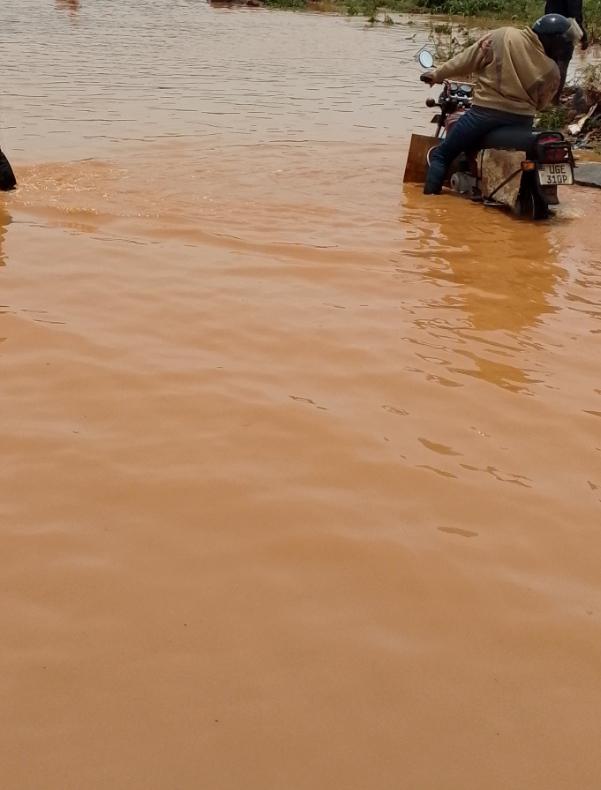
On Wednesday, those staying in Kampala and it’s neighborhood witnessed unprecedented water levels in form of floods following a heavy downpour.
Lives and properties weren’t spared with some homes being submerged while roads also got flooded.

According to the world of Metrologists, there are various classifications of every amount of rain that falls on the ground. These include light rain, moderate rain, strong rain, rainfall, heavy rain and very heavy rain.
Light rain ranges between 2-4mm in a day, meaning there are 0.16mm recorded per hour. On moderate, the rain gives 5-6mm in a day translating into 0.19-0.25mm per hour.
As for strong rains, this gives out between 15-20mm a day implying that in every hour that passes, 0.83mm is recorded!
Coming to what they call heavy rains, this amounts to 31-70mm received in a day meaning a 2.97mm recorded per hour while Very Heavy rains range between 71-150mm a day. This translates into a 6.25mm being recorded per hour! There are also showers that are referred to as violent and these exceed 50mm per hour while any amount of rain that falls at a rate of 4mm or more per hour is termed as Heavy rain.
Excess rain is obtained if the downpour is recorded at 30mm in a day translating into 1.25mm of rain recorded per hour.
Now, according to metrologists at Makerere weather station, the rains which occured in Kampala on Wednesday were recorded at 82mm!
And not that 82mm were recorded in 24hrs, but these were received in a record 6hours! This therefore, meant that in every hour, 13.7mm pounded the city resulting into unprecedented flooding of roads!
“The rainfall based on the weather station at Makerere University, rainfall was recorded at 82mm” explained ED Sharifah Buzeki adding that experts informed the Authority that this amount of rainfall is usually expected in a [full] week.
“But is was received within the morning hours. The experts said it was (therefore) beyond the capacity of the current drainage system” she explained.
Buzeki said this situation would require improvement on the Kampala drainage system to be able to absorb rainfall of more than 80mm received within a period of 6 hours like the one of Wednesday.

The Executive Director assured Kampalans that the Authority is making efforts to ensure that the existing drainage channels are fully functional as plans to improve on them further take shape, given the changing climate patterns.
“That’s why we’re emphasizing discipline on the way we dispose of rubbish. People must be responsible because even the existing channels are being blocked by rubbish. This is something we should all take serious if we are to achieve a cleaner City” she urged.
Buzeki said currently, the KCCA Teams have been busy with clearing all blocked drainage channels following the Wednesday heavy downpour.
PRECEDENT
According to research, the greatest rainfall to have occured in 24hours happened on January 7th-8th 1966 in Foc-Foc La Reunion, an Island in the Southern Indian Ocean. It occured in a day with the passage of Cyclone Denise. Here, it left floods measuring 1.825meters high or 71.8inches. However, experts suggest that the Wednesday floods which occured as a result of the 6-hr downpour almost measured the same height as those at Foc-Foc islands which came after 24hours!