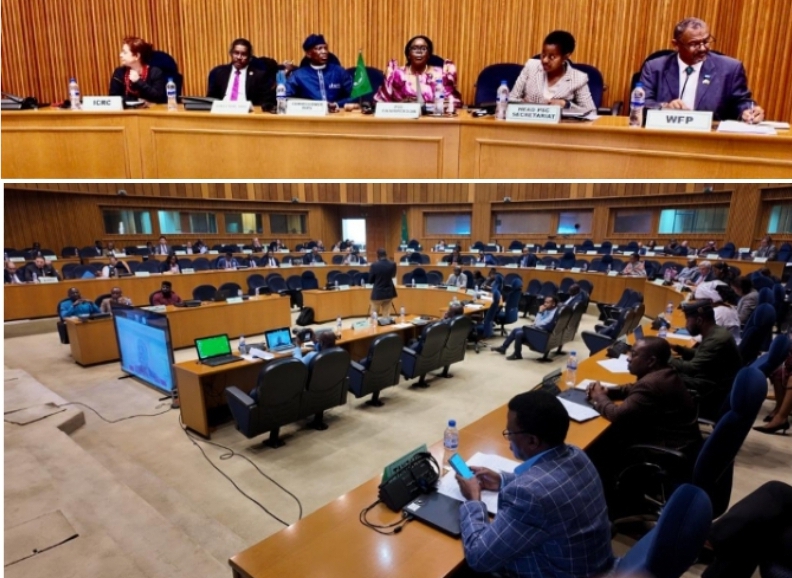
The African Union (AU) Peace and Security Council (PSC) has convened for its 1286th session, in which Uganda expressed concern over Africa’s protracted crises.
According to Uganda’s Permanent Representative to the African Union/IGAD and UNECA also ambassador to Ethiopia, H.E Amb. Rebecca Amuge Otengo, the crises which include conflict, climate shocks, disasters and displacement continue to affect millions of people on the continent and yet financial support to the Humanitarian actions is dwindling.

She made the statement during her opening remarks as she chaired an Open Session on the Humanitarian Situation in Africa. Otengo on behalf of President Museveni, is chairing the AU-PSC for the whole Month of July.
She stressed the devastating impact of climate change and Gender-Based Violence which she added has led to destruction of livelihoods.
Otengo called for greater international support for refugees, IDPs and host communities.
Besides Otengo, other notable speeches expected in this session include one from Bankole Adeoye, Commissioner for Political Affairs, Peace and Security (PAPS). It is also expected that Amma Adomaa Twum-Amoah, Commissioner for Health, Humanitarian Affairs and Social Development (HHS); Churchill Ewumbue-Monono, Permanent Representative of Cameroon and Chairperson of the PRC Sub-Committee on Refugees, returnees, IDPs and Migration; along with the United Nations High Commissioner for Refugees (UNHCR), the International Committee of the Red Cross (ICRC) and the World Food Program (WFP), will brief the Council.
The session is being convened within the framework of the PSC’s annual indicative program of work, with the humanitarian situation in Africa forming part of the thematic standing agenda of the PSC. The last time the PSC convened a session to look at the humanitarian situation in Africa was during its 1239th session on 19 October 2024, where it received a briefing from the ICRC on its activities on the continent.
According to Otengo, the worsening humanitarian situation in Africa is reaching unprecedented levels due to protracted conflict, climate change, economic fragility, and widening resource gaps, as well as a lack of international attention and mobilization.
Reports from humanitarian actors indicate that the lethal convergence of violent conflict, climate change-induced disasters, and acute funding gaps has resulted in millions across the continent living in conditions of extreme vulnerability and suffering.
“Conflict remains a major driver of humanitarian need, with countries such as Sudan, the Democratic Republic of the Congo (DRC), and South Sudan facing escalating levels of displacement, food insecurity, and systemic breakdowns in health and basic services, mainly due to conflicts” she said.
According to Amani Africa, latest figures from humanitarian agencies show that in Sudan alone, over 30 million people, more than 63% of the population, are in dire need of humanitarian assistance.
The conflict between the Sudanese Armed Forces (SAF) and the Rapid Support Forces (RSF), which erupted in April 2023, has led to the forcible displacement of over 12 million people internally and across borders, representing the largest displacement crisis in the world.

Despite the enormity of need, the international humanitarian response has been woefully underfunded. As of April 2025, only 10% of the $4.2 billion appeal to address what has been recognised as the most severe humanitarian emergency in the world had been met, clearly demonstrating the growing disconnect between humanitarian need and global solidarity.
In addition to the scale of the humanitarian need and the growing gap in the resources required for meeting such need, aggravating the dire humanitarian situation is the shrinking humanitarian space, on account of the disregard by conflict parties of humanitarian principles and IHL rules. Thus, in Sudan, the weaponisation of humanitarian aid, especially food, by the warring parties has compounded the suffering of people caught up in the crossfire of violence, with reports of aid blockades and starvation being used as weapons of war, in complete disregard and direct breach of international humanitarian law (IHL) rules. As a result, parts of Sudan, such as Darfur, have been designated as territories classified as having famine conditions.
The DRC presents another grim illustration, particularly of protracted humanitarian distress resulting mainly from conflicts for over two decades.
The country now hosts the highest number of internally displaced people ever recorded within its borders, over 7.3 million. Conflict continues to disrupt food systems, healthcare, and shelter, with approximately 27.7 million people expected to face Crisis (IPC Phase 3) or worse food insecurity between January and June 2025. The impacts of climate shocks add to the plight of people in the country; seasonal floods in early 2025 damaged infrastructure in Kinshasa and Equateur, affecting over 60,000 people.
South Sudan’s protracted crisis also demands urgent attention. In 2025, 9.3 million people within the country require humanitarian aid, with an additional 4.3 million South Sudanese living in displacement due to conflict, environmental shocks, and economic collapse. These intersecting drivers of vulnerability highlight the imperative for ensuring the implementation of the peace process and completing the transitional period in order to create space for a more focused policy action involving both preparedness and response to climatic distress.
In addition to these, the Norwegian Refugee Council’s (NRC) 2025 report indicates that 8 of the world’s 10 most neglected humanitarian crises are located in Africa, including those in Cameroon, Ethiopia, Mozambique, Burkina Faso, Mali, Uganda, and Somalia.
However, despite the scale of the humanitarian crises represented by the staggering figures, the international response has fallen drastically short, and Africa’s humanitarian financing landscape remains starkly inadequate. According to the UN Office for the Coordination of Humanitarian Affairs (OCHA), over half of the global $25 billion appeal for humanitarian assistance went unmet in 2024. Within Africa, funding gaps were particularly severe. Burkina Faso, for instance, received only 27% of its appeal.