By John Okello Lapok
President Museveni has urged judicial officers to prioritise Alternative Dispute Resolution (ADR) mechanisms as a means of addressing the Judiciary’s long-standing backlog across the country.

“Courts should not be the first stop for every dispute. Judges must actively manage cases and guide parties toward appropriate resolution mechanisms. This reduces pressure on the Judiciary and allows courts to focus on serious and complex matters,” Museveni said.
He further argued that our Constitution itself acknowledges this (ADR) by providing for traditional and cultural leaders in the administration of justice.
“The promotion of Alternative Justice Systems (AJS) is not a step backward; it is a step inward towards a justice system that is more accessible, more understandable, and more meaningful to the ordinary Ugandan. When our people see themselves in the justice system, they trust it more. And a trusted judiciary is a strong judiciary,” he said.
ADR mechanisms include mediation, negotiation, conciliation, arbitration and plea bargaining among others.
Museveni stressed that Uganda has long traditions of resolving disputes through dialogue and reconciliation thus encouraging judicial officers to address ADR and Alternative Justice Systems, case management in complex matters, sentencing consistency, technology, and judicial leadership arguing that, the above are practical tools for improving performance and restoring public confidence.
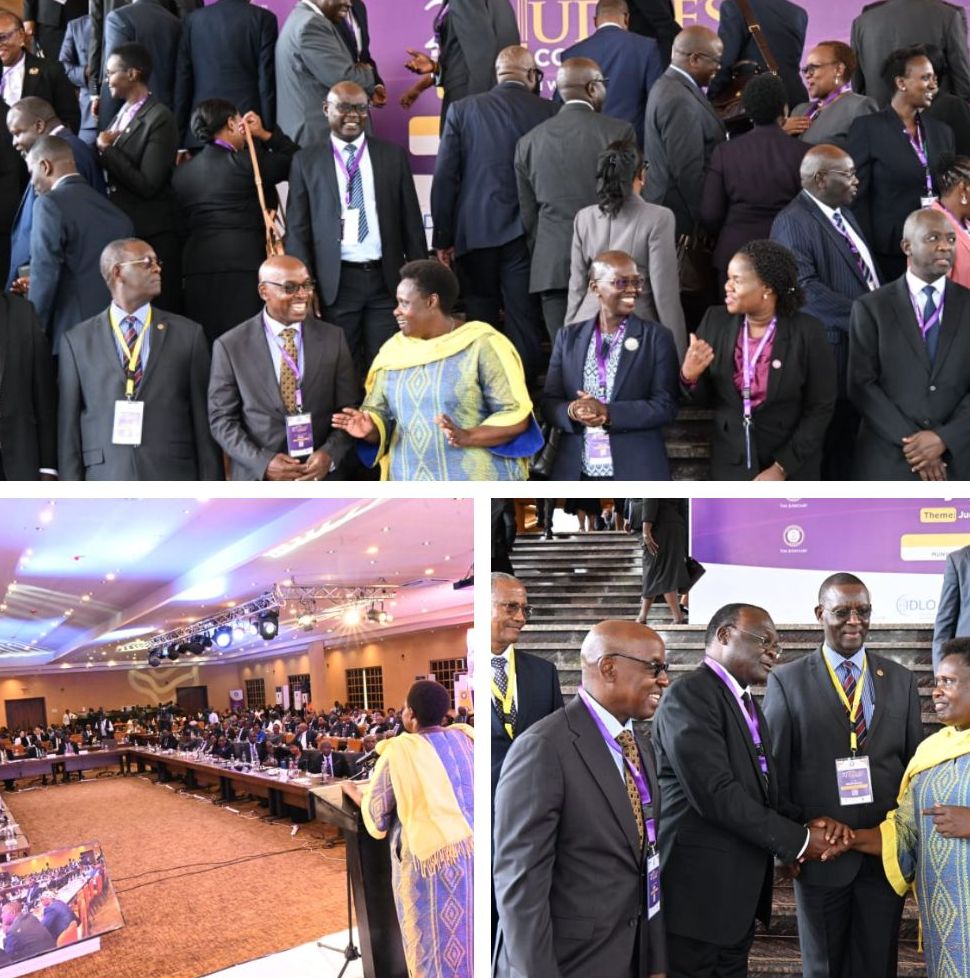
He made the remarks in a speech delivered for him by the Vice President Maj. (Rtd) Jessica Alupo during the opening of the 27th Annual Judges’ Conference at Speke Resort Munyonyo today February 2, 2026.
According to the 2025 Judiciary National Court Case Census report, 46,542 out of 167,353 unresolved cases are classified as backlogs.
A case is categorized as a backlog if it has remained in the judicial system for two years or more.
The President informed the judges that a strong, independent, and efficient Judiciary is indispensable to democracy, peace, and national development as it underpins investor confidence, protects rights, resolves disputes, and maintains social order.
“This is why we continue to support judicial infrastructure expansion, staffing, training, and institutional reform — even as we demand discipline, integrity, and accountability,” he said.

Museveni said the NRM Manifesto is anchored on building a stable, disciplined and productive society governed by strong and effective institutions.
He said that under National Development Plan V, Government has prioritised human capital development, public sector efficiency, and institutional performance as key drivers of socio-economic transformation, and that the Judiciary is central to this agenda.
The president acknowledged that it is in that context that the theme for the this year’s judges conference; “Judicial Wellness: A Tool for Effective Case Management” becomes particularly relevant.
“Judicial wellness is therefore not a peripheral concern; it is a strategic governance issue. A healthy, organised and well-led Judiciary is a productive Judiciary; one that clears cases faster, manages pressure better and delivers predictable justice. It is both timely and strategic,” he said.
He further said our 1995 Constitution is clear. “Judicial power is derived from the people and must be exercised in their name, in accordance with their values and for their benefit. Justice must therefore be accessible, timely, impartial and respectful,” he said.
Museveni however noted, that this constitutional promise cannot be fully realized if those who administer justice are overwhelmed, exhausted, or unsupported.
He reminded the judicial officers that effective justice systems lie at the very heart of every democratic country, emphasizing that no country that can be stable, prosperous, or sovereign without an effective system of justice.
“When we took responsibility for leadership in 1986, Uganda had suffered institutional breakdown, impunity and disorder and due to this breakdown, the country was suffering from high levels of lawlessness and high handedness. One of our central tasks was to restore authority, discipline, and respect for the law,” the president said.
Museveni told the judges that work must be sustained, “Our people should experience justice not in legal theory, but in time taken to resolve disputes, the cost involved, and the certainty of outcomes. When cases delay, citizens lose confidence, investors hesitate, and social tensions rise. Justice delayed is therefore justice denied. That is why I have consistently emphasised speed, efficiency, and discipline across all state institutions — including the Judiciary,” he said.
He added that backlogs are not caused by laws alone but arise from systems, organisation, leadership, and human capacity. “Judges are human beings. They carry heavy workloads, face public pressure, and handle emotionally demanding matters. If that pressure is not well managed, it affects output,’’ he said.
He also mentioned fatigue as one of the factors which leads to delay; saying delay leads to dissatisfaction; dissatisfaction leads to instability, so to say the strength of our justice system ultimately depends on the physical, mental, and ethical wellbeing of those entrusted with judicial power.
The President acknowledged the leadership of the Judiciary during this period of transition. He commended the retiring Chief Justice Alphonse Owiny Dollo for his dedicated service to the nation and for the reforms undertaken during his tenure.
“In particular, the deliberate re-engineering of Alternative Dispute Resolution and Alternative Justice Systems that laid a firm institutional foundation for mediation, reconciliation, and community-based justice,” he said.
Museveni said the above reforms strengthened access to justice, reduced pressure on formal courts, and advanced the Africanisation of justice by promoting approaches that are restorative, practical, and rooted in our values and traditions.
He stressed that this contribution has provided a coordinated framework for positioning ADR as a central pillar of justice delivery.
Museveni congratulated His Lordship, the Chief Justice, Hon. Justice Dr. Flavian Zeija, upon assuming this important responsibility.
The President urged the conference to focus on practical solutions that reduce backlog, improve turnaround time, and strengthen public confidence.
He further said every completed land, commercial, and criminal disputes enhances the economic development of the country. “The wananchi are watching. They want results,” Museveni said.