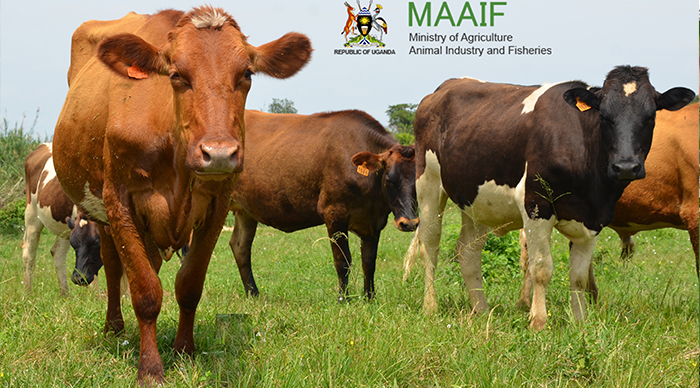
KAMPALA — As Uganda marks 40 years since the 1986 liberation, the rapid expansion of the dairy and fisheries subsectors is emerging as a powerful reflection of how sustained stability and long-term investment have transformed rural livelihoods.
Once dominated by low productivity and informal trade, both industries have evolved into major contributors to household incomes, national nutrition and export earnings — a shift agricultural leaders say mirrors the broader economic progress achieved over four decades.

Maj. Gen. David Kasura-Kyomukama, Permanent Secretary at the Ministry of Agriculture, Animal Industry and Fisheries, said national milk production nearly doubled from 2.81 billion litres in FY 2020/21 to 5.3 billion litres in FY 2024/25. Over the same period, export earnings from milk and milk products rose sharply from USD 92.4 million to USD 280 million. Uganda now boasts 145 dairy processing facilities with a combined installed capacity of 3.4 million litres per day, operating at about 68.7 percent utilisation.
“These gains show how far we have come in modernising livestock production, improving breeds, strengthening standards and expanding value addition,” Kasura said, noting that dairy farming has become a reliable source of income for hundreds of thousands of households, especially in the cattle corridor.
He said government support in artificial insemination, breed improvement, enforcement of quality standards and processing capacity has enabled farmers to move from subsistence milk production to commercial dairy enterprises linked to regional and international markets.
In the fisheries subsector, similar progress is being recorded. Kasura noted that fisheries contribute about 3 percent of Uganda’s GDP and 12 percent of agricultural GDP, supporting around 1.2 million Ugandans directly in capture fisheries, alongside thousands more in processing and trade. Fish production increased from 621,987 tonnes in 2021 to 728,369 tonnes in 2023, while the beach value of fish rose from UGX 1.875 trillion to UGX 2.200 trillion over the same period.
He said investments in regulation, enforcement, processing standards and aquaculture promotion are helping restore fish stocks while strengthening export competitiveness.
As the country reflects on four decades of relative peace and consistent policy direction, many communities see the growth of dairy and fisheries as evidence that agriculture is no longer just about survival, but about enterprise, trade and long-term prosperity. With continued focus on value addition and market expansion, the two subsectors are increasingly viewed as pillars of Uganda’s journey toward a modern, export-driven agricultural economy.