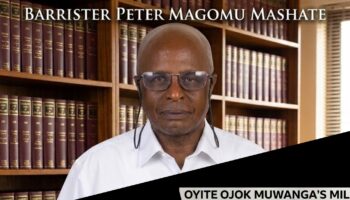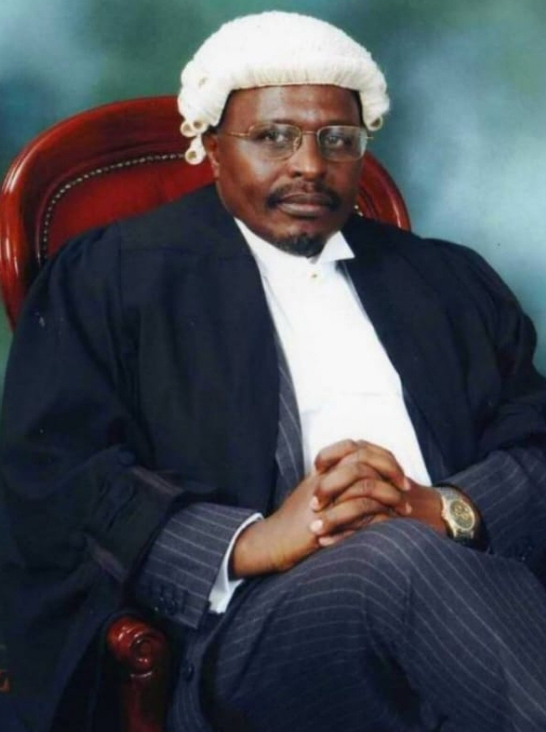
By Peter Magomu Mashate
Last week’s sanctions slapped on Rt.Hon. Anita Annet Among, the speaker of Parliament and two former ministers over aggravated corruption allegations are now the talk in the political corridors all over.

The charges are reminiscent of a case that was brought against the person of H.E Yoweri Museveni and government of Uganda in 2007. The only difference is that whereas the said case against the president was initiated by an actor of the private realm, the sanctions we’re grappling with now have been brought by the government of United Kingdom.
I was the one who led the legal team that defended H.E the president in the UK court and finally we won that matter.
Comparing the president’s case and the sanctions against the speaker the the co-sanctioned, one clearly sees that the two cases are different and therefore require different approaches to resolve.
First of all, in the president’s case fell under the ambit of jurisdiction of courts of law and the UK court were competent and therefore seized of this matter.
In which case, the doctrine of separation of powers was in full force. This is because while the president was fully entitled to shun the case brought against his person on account of the Diplomatic and Sovereign Immunity Act 1972 (as amended), which Act accords immunity to sitting Heads of State, this didn’t happen because of the doctrine of separation of powers between the executive, legislature and judiciary in UK.
Not even the Foreign Office or the Prime Minister’s Office or the Prime Minister himself of UK for that matter could be allowed to make diplomatic representations to discontinue the case at hand.
However, on this occasion, the sanctions are Legal, Diplomatic and Moral.
Diplomatic in a sense that UK treats Uganda as a sovereign state because it’s a member not only of the Commonwealth family of nations but also a member of the UN family of Nations which accredits sovereignty to nations.
Legal because they touch on a matter that has gone through the due process including investigation and prosecution of some of the sanctionees in the Ugandan Anti-Corruption Court. It is actually possibly because of this that, even H.E the president recently decided to make what he called a Slight Amendment to his cabinet where he put aside two ministers variously mentioned in the Mabaati saga who are again subject of the sanctions.
Moral in a sense that even when H.E had all powers and protection from prosecution pursuant to the aforementioned Act, he found it morally right to set the records straight by participating in the proceedings in the jurisdiction of the judiciary.

That’s why he personally instructed me to assemble a team comprising Counsel Patrick Asiimwe and others and we defended him and we ably executed that assignment. Therefore, these sanctions are not about government of Uganda to warrant Diplomatic engagement but rather personal liability for the individual involved.
The ball therefore, remains in the court of the sanctionees who could (if they choose) challenge the legality of these sanctions by petitioning UK court by way of judicial review.
This is because the UK government department which sanctioned them is a public office and therefore amenable to Judicial review by anyone who has a locus standi in the matter. This could include any Ugandan living in UK or anywhere in the world.
But the proceedings must be filed in UK courts because the cause of action arises in the UK by reason of the sanctions not in Uganda.
It is completely erroneous for anyone to argue that a legal challenge against British sanctions can be lodged in Ugandan courts. It will be a futile attempt as decisions will not be enforced against the UK government.
The argument that the sanctions were as a result of the passing of the Anti-gay Act may not be sustainable in the UK courts as this is not the first time Ugandan parliament has passed such an important law. It was at first passed by the 9th parliament under Rt. Hon. Rebecca Kadaga and duly assented to by H.E the president in 2015 but no such sanctions were ever brought against Kadaga, the President and the mover of the bill Hon. David Bahati. In fact, I remember seeing Rt. Hon. Kadaga attending various international meetings and conferences in Europe where she defended Uganda’s position on this matter and nothing was done to her to date. If indeed this Law caused these sanctions, an application could as well be made in the same proceedings for the court to lift the veil to examine any underlying ulterior motive. This would enable those sanctioned to plead under article 14 of the European convention on Human Rights citing discriminatory treatment.
The writer is a London-based Constitutional and Human Rights Barrister-at-Law of the Honourable society of Lincoln’s Inn of court London (United Kingdom).