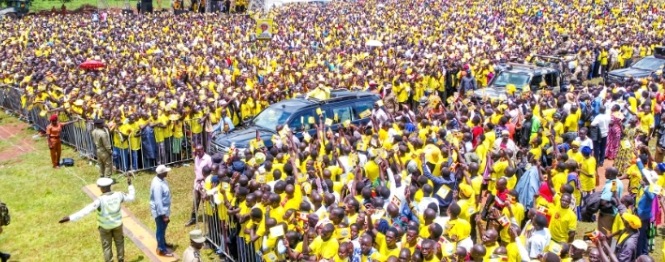
President Yoweri Kaguta Museveni, who is also the National Resistance Movement (NRM) Presidential candidate in the 2026 general elections has said that if his NRM comes back to power, it will not allow oil cash to be used to import luxurious items for women like wigs and perfumes. Instead, he said, the money accruing from oil shall be used for development projects like roads and electricity. He made the remarks as he addressed crowds in Packwach district upon resumption of his campaigns.
The President urged the people of West Nile to vote for the NRM, which he said has preserved peace and unity in Uganda for decades, laying the foundation for the region’s transformation from a once volatile zone into a stable area.

“When the NRM came to power, many of you were in exile in Congo and South Sudan. I hear that many of you were born there, but when the NRM came, we reconciled, and you people came back immediately. So, you’re the best witnesses to talk about the strength of the NRM,” H.E Museveni told the cheering crowd.
The President contrasted Uganda’s stability with the instability in neighbouring South Sudan and the Democratic Republic of Congo, noting that Uganda’s peaceful environment has made it a refuge centre for people fleeing conflict in the region.
“But also, you’re neighbors to Congo and South Sudan, and you know what’s happening there. Uganda is now hosting very many refugees, and you know those refugees. So you’re the best witness,” he added.
The NRM Presidential candidate used the rally to reflect on his political journey, tracing the roots of the NRM’s ideology back to the 1960s. He explained that his involvement in politics began in 1960, long before the liberation struggle, at a time when Uganda’s politics was polarized along tribal and religious lines.
“When you’re supporting the NRM, you should know the reasons you’re supporting it for. The NRM has been involved for the last 65 years. I myself started in the 1960s, and the youths were in the old political parties, DP, UPC, and Kabaka Yekka. The problem was that those parties were based on sectarian grounds of tribes and religion,” President Museveni said.
“In 1971, we formed FRONASA, which became part of the liberation struggle. Since then, we have always supported what is right and opposed what is wrong,” the President added, emphasizing that the NRM’s foundation was built on national unity, not sectarianism, and that this ideological commitment has ensured peace and stability across Uganda.
President Museveni further outlined key achievements under the NRM government, dividing development into two categories — economic infrastructure and social infrastructure.
He cited major road works such as the Karuma–Pakwach–Nebbi–Arua–Koboko road, which he said is being repaired, and the expansion of electricity and telephone connectivity as examples of the economic infrastructure that has enabled development in the region.
On social infrastructure, President Museveni noted significant progress in education and health in Pakwach District.
He said the district now has 64 government primary schools and 8 government secondary schools, though 20 of the 68 parishes still lack primary schools.

“When you support the NRM, you should know the reasons why. We shall ensure that every parish has a government primary school, and every sub-county has a secondary school,” President Museveni pledged.
The President contrasted current educational progress with the early 1960s, when secondary schools were few and concentrated in central and western Uganda.
“When I was in Senior One at Ntare School in 1961, there was no single secondary school in West Nile, Acholi, Lango, or Teso. Today, every district has schools — that is progress,” he said.
Turning to the health sector, the President noted that out of the 10 sub-counties in Pakwach, only one has a Health Centre IV.
He acknowledged demands from local leaders for a district hospital and promised to consider the request within the national budget framework.
President Museveni cautioned the public against making unrealistic demands without considering the available resources.
“I was in Oyam district earlier today and they want to divide it into two districts. Then I said what do we do with the roads, and they said forget about the road, and we get the district. You have to be serious with your demands,” President Museveni said.
The President explained that while the government continues to expand infrastructure, it must balance national priorities.
President Museveni also highlighted Uganda’s emerging oil sector as a new source of national wealth, noting that petroleum production is set to begin next year.
“The good thing is that God is always with the NRM. The British were here for over 60 years and failed to find oil. We discovered it, and next year we shall start pumping,” he said, assuring Ugandans that oil revenues would be used responsibly for national development.
“If you elect NRM, we shall not allow our oil money to import perfumes, wigs, whisky, and so on. The oil money will be used for major roads, electricity for science development, and some of the health units, like you’re saying,” he said.
A large part of President Museveni’s message focused on household wealth creation, which he said is central to the NRM’s economic transformation agenda.
Using a rhetorical question, the President explained the difference between infrastructure and wealth.
“If you work on the road from Karuma to Pakwach to Nebbi to Arua all the way to Koboko, and we have built these schools you have said here, the question is, do you sleep on the road at night? Or do you sleep in the school? Or the health center unless you’re sick? At night, you need to sleep in your own house. From the rally here, you’ll go back to your home (paco para) at night, the poverty you left there in the morning will be waiting for you and will welcome you back,” President Museveni said.