By John Okello Lapok
The Chief of Defense Forces, Gen. Muhoozi Kainerugaba, has brought a new chapter into Uganda’s benchmarking package, proving to the country that such visits must always translate into practical projects.

Uganda could therefore be at a different stage if all other MDAs that travel to different countries could replicate his approach of benchmarking.
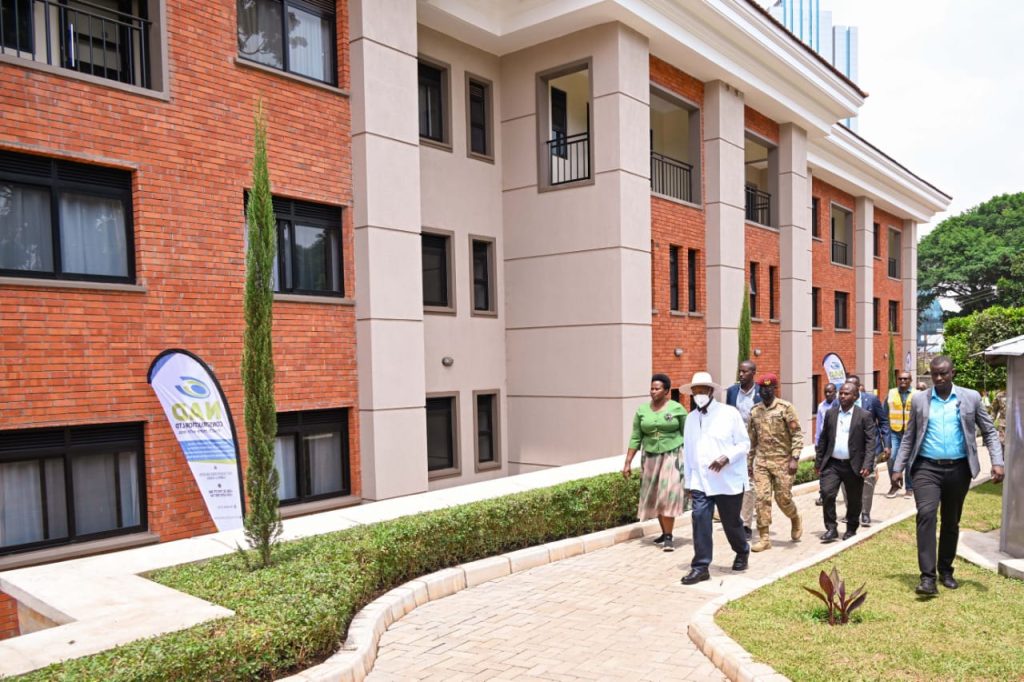
In just a few years as Chief of Defense Forces (CDF), Gen. Muhoozi Kainerugaba has continued to deliver results; most recently, the Commander-in-Chief, Gen. Yoweri Museveni, commissioned the state-of-the-art SFC accommodation facilities at State House-Nakasero.
According to H.E. the President, Gen. Yoweri Museveni, this investment is part of the efforts to improve the welfare, discipline and operational readiness of Uganda’s armed forces.
The President credited the CDF Gen. Muhoozi for supporting efforts to channel resources towards military infrastructure.
“He would get that money which was used for operations and instead use it to build barracks. We were always insisting that commanders must stay in the barracks,” Gen. Museveni said of Muhoozi, noting that accommodating soldiers together was not only a welfare matter, but also a strategic move especially during times of conflict.
Muhoozi’s footmarks are also visible in other key infrastructure, including roads, health centers, and redevelopments in the Capital City, among others.
TRACING GEN. MUHOOZI KAINERUGABA’S VISITS TO ETHIOPIA
In recent years, Gen. Muhoozi has, for example, visited Ethiopia, a strategic country that hosts the African Union headquarters.
During such high-level visits in Addis Ababa, Gen. Muhoozi has engaged the highest leadership, MDAs, including the military leadership, and the private sector.
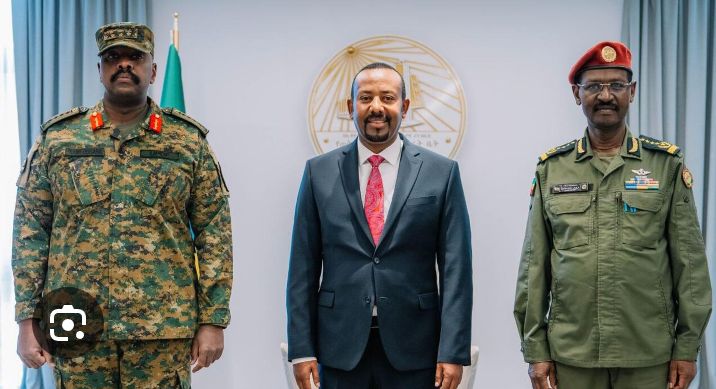
Among the high-level engagements included one with H.E. Dr. Abiy Ahmed, the Prime Minister of the Federal Democratic Republic of Ethiopia, and his counterpart, the Chief of General Staff of the Ethiopian National Defense Force ( ENDF) Field Martial Birhanu Jula.

Our inspector contacted Uganda’s Ambassador to Ethiopia, also the Permanent Representative to the African Union, IGAD and UNECA, H.E. Rebecca Amuge Otengo for her take on Gen. Muhoozi’s visits to Ethiopia.
She praised the CDF for always being a practical and results-oriented officer, noting that his approach to benchmarking is already bearing fruit and therefore the way to go.
“His approach begins with boardroom visits, spends more time in the field, and then gets back for debriefing. As Uganda’s Permanent Mission in Addis Ababa, we have been honored with his visits to all our areas of accreditation, including the Republic of Djibouti, which hosts the IGAD Headquarters, and Ethiopia, which hosts the African Union and UNECA. We should also recall that he visited Somalia, where we work in close coordination with Uganda’s Mission in Mogadishu because of our troops in that country under the African Union Support and Stabilization Mission in Somalia ( AUSSOM).” she told The Inspector.
As the head of the Mission, she was honored to accompany him to some of those visits, including the Grand Ethiopian Renaissance Dam (GERD), Bole and Bishoftu Airports, METEC / Ethio-Engineering, Digital Policing, Defence Headquarters, Ethiopian Air Force, AI and Robotics Centre, Ring Roads and Transport Corridors, Addis Ababa City Redevelopment, and Beautification and Riverside Development
She noted that this has resulted in exchange visits, capacity building, greening, beautification and redevelopment of roads in the city and mega projects like the barracks being built in Mbuya, among others.
Amb. Otengo noted that in all visits Gen. Muhoozi made, his catchword was ‘THIS CAN BE DONE AT HOME.’
She said that as the head of Mission, she carefully listened to Gen. Muhoozi’s questions during those visits, all of which were strategic in nature and aligned with his catchword. She outlined the questions including;
THE STRATEGIC QUESTIONS
1. What national problem or strategic priority was the project designed to address, and what were its original objectives and expected results?
2. How was the project conceived, planned, approved, and coordinated, and which institutions were responsible for its leadership and implementation?
3. What legal, policy, regulatory and institutional frameworks were necessary to support successful implementation?
4. How was the project financed, what was its total cost, and what mechanisms were used to ensure value for money, transparency and accountability?
5. What implementation model was used, including procurement, timelines, major milestones, stakeholder participation, land acquisition and management of implementation challenges?
6. What role did local companies, labour, materials and expertise play, and how was foreign technology, knowledge and expertise transferred to local institutions and personnel?
7. What technologies, digital systems, cybersecurity arrangements and specialised skills are required to operate, protect and maintain the project?
8. How is the project operated, maintained, monitored and financed after completion, and what arrangements ensure its long-term financial and technical sustainability?
9. What measurable economic, social, employment, development or security benefits has the project produced, and what lessons have been learned from its performance?
10. Which elements of the model can realistically be adapted to Uganda, at what approximate cost and conditions, and what opportunities exist for pilot implementation, technical cooperation, training, technology transfer and continued institutional follow-up?
“The way he does it, we feel that is the way to go. We see now exchange visits, capacity building, greening, beautification and redevelopment of roads in the city, among others,” she said.
As Gen. Muhoozi’s catchword goes, implementation of some of those projects is already underway, while others like that of Nakasero, among others, have been completed and commissioned.