
By John Okello Lapok
The Department of Agricultural Extension and Skills Development has made significant strides in strengthening Uganda’s agricultural advisory system and improving the technical capacity of extension workers nationwide. A central focus of the department was capacity building for district-level agricultural staff. More than 630 district extension officers and agricultural staff participated in nationwide training programmes that emphasised agricultural planning, monitoring, data collection, digital extension methods, climate-smart agriculture, and reporting systems. These trainings standardised technical knowledge across districts, ensuring that extension messaging aligned with national production targets and value-chain priorities.

In parallel, the department implemented extensive farmer skills development initiatives. Through on-farm demonstrations, practical field clinics, and structured training sessions, thousands of farmers gained knowledge on good agronomic practices, proper use of inputs, post-harvest handling, and enterprise management. By linking farmers to trained extension workers, the department contributed to wider adoption of improved seeds, fertilizers, and modern production practices, fostering a transition from subsistence to commercial agriculture.
A major advancement during the period was the enhancement of digital agricultural information systems. The Agricultural Extension Management System (AEMS) was upgraded, enabling districts to feed real-time data on extension activities, including households served, advisory services delivered, and distribution of government inputs. This strengthened data flow improved planning, reporting, and performance monitoring of extension services nationwide.
The department also expanded farmer institutional development by supporting cooperatives, farmer groups, and community-based organizations. Farmer mobilization exercises guided groups on enterprise selection, resource management, and linkage to extension services, improving collective access to inputs and enhancing dissemination of technical knowledge at the community level. Through the Parish Development Model (PDM), parish-level agriculture workers were trained on enterprise selection, farmer profiling, and record-keeping, ensuring that household-level production aligned with agro-ecological conditions.
Youth and women-focused skills workshops further strengthened agri-enterprise capacity, targeting sectors such as fruits, vegetables, poultry, piggery, and apiary. By promoting hands-on learning, the department enhanced the capacity of young farmers to establish profitable, sustainable enterprises. Partnerships with development organizations such as the World Bank, EU, FAO, IFAD, and JICA were also critical, providing additional training, farm inputs, and demonstration materials, thereby expanding the reach of extension services beyond government budgets.
Monitoring and supervision were reinforced through field visits across more than 60 districts, evaluating training quality, functionality of extension structures, and staff performance. These inspections generated actionable recommendations for improved coordination, accountability, and service delivery. The department additionally developed standardized extension communication materials—including guidelines, manuals, leaflets, posters, and training aids—which improved the accuracy and consistency of technical information delivered to farmers. ICT-based innovations such as SMS alerts, radio programs, WhatsApp groups, and digital farmer databases enhanced communication flow and accessibility of advisory services during peak agricultural periods.
Collectively, these interventions significantly strengthened Uganda’s extension ecosystem, increased farmer productivity, promoted adoption of improved technologies, and supported the broader national vision of agro-industrialisation.
DEPARTMENT OF AGRICULTURAL INVESTMENT AND ENTERPRISE DEVELOPMENT’S GAINS
The Department of Agricultural Investment and Enterprise Development contributed decisively to Uganda’s agro-industrialisation agenda by driving enterprise growth, farmer commercialisation, cooperative strengthening, and financial inclusion. A key milestone was the expansion of agricultural enterprise financing under the Uganda Development Bank (UDB) interest-subsidy loan facility through the Buy Uganda Build Uganda (BUBU) programme. During the reporting year, UGX 15 billion of the UGX 25 billion allocated was released, resulting in a remarkable increase in agricultural loans from 201 to 1,223, a more than sixfold rise.
The department also implemented a large-scale farmer grant scheme, disbursing UGX 32.29 billion to 6,738 farmers across 41 districts. These grants enabled investment in improved technologies, inputs, and small-scale processing equipment, strengthening grassroots enterprises and supporting the shift to commercial farming. Complementary interventions in sustainable land management stabilized 248 hectares of degraded land through contour bunds, trenches, and soil conservation structures. Distribution of 76.5 tons of indigenous and climate-resilient seeds to 3,390 households strengthened enterprise resilience, while adoption of improved root and tuber technologies reached 84%, seed adoption 55%, and fertilizer use 14%.
Enterprise incubation was another area of notable achievement. Through the Peace Initiative for Skills Development in Agriculture, 25 agricultural incubators were established across 18 regions, training 375 beneficiaries—including youth and women entrepreneurs—in technical skills for commercial agricultural ventures. Cooperative development also advanced under the national cooperative transformation strategy, with over 3.7 million farmer groups and 45,800 fully registered cooperatives now operational, facilitating bulking, marketing, credit access, and enterprise coordination. The department also promoted market-oriented enterprise selection and linked households to financial services, training, and value-chain support to ensure integrated agribusiness development.

The department strengthened enterprise data systems and digital tools, improving tracking of cooperative growth and enterprise performance. Climate-smart interventions supported households in vulnerable regions, particularly in the cattle corridor and Karamoja, with drought-tolerant crops and resilient enterprise models. Cross-directorate collaboration ensured that enterprise support packages aligned with value-chain strategies in oilseeds, dairy, coffee, fruits, poultry, and maize, creating a cohesive framework for agro-industrialization. These efforts collectively enhanced productivity, increased household incomes, created rural employment, and strengthened Uganda’s agricultural enterprise ecosystem.
DEPARTMENT OF AGRICULTURAL ENGINEERING AND AGRICULTURE DEVELOPMENT ACHIEVEMENTS
The Department of Agricultural Engineering and Agriculture Development delivered significant interventions in irrigation, mechanization, soil conservation, and farmland planning. Under the Water for Agricultural Production division, the Ministry constructed 32 valley tanks and 11 valley dams, adding over 1.2 million cubic meters of storage capacity.
Additionally, 44 existing valley tanks were rehabilitated, and 32 solar-powered mini-irrigation systems installed, contributing to a total of 16,464 hectares under irrigation. These interventions stabilized production in drought-prone zones, supported horticulture expansion, and improved livestock watering.
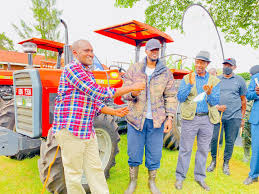
Mechanization efforts included procurement and distribution of 100 mechanization units and construction of three mechanization centers to provide training, repair, and hire services. Over 300 tractor operators and technicians received training in machinery operation, servicing, and safety, improving the national mechanization rate and expanding commercial production. Infrastructure development included five dairy mini-processing units, 22 community bulk grain stores, and rehabilitation of farm access roads, enhancing linkages between farms and agro-industrial hubs.
Soil and Water Conservation interventions covered 248 hectares of degraded land, including contour bunds, terraces, infiltration ditches, and re-vegetation, coupled with training 1,200 farmers and extension workers in soil management and climate-resilient practices. Collaboration with NARO produced five soil suitability maps, exceeding targets and enhancing evidence-based farm planning.
Under Farmland Planning and Management, the department developed farm plans, provided enterprise zoning guidance, and rolled out mobile soil testing services to inform fertilizer application and crop selection. Forty-seven mobile plant clinics with 247 diagnostic kits enhanced field-level pest and disease diagnostics in districts including Kumi, Hoima, Kazo, and Moroto. These initiatives collectively strengthened infrastructure, mechanization, land-use planning, and climate-resilient production, driving Uganda’s agro-industrialization agenda.
Happy 40th NRM Liberation Day!