President Museveni has expressed sadness with the wanainchi including ghetto youth for continuously sending him ‘counterfeit’ individuals to occupy seats in parliament.
The Head of State reminded the people including ghetto youth of their duty to ensure that people of high integrity are elected to lead them in Parliament and Local Governments in order for them to get services as planned by government.

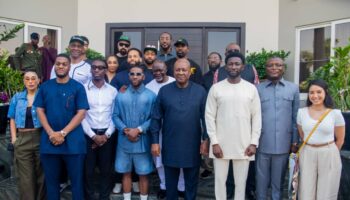
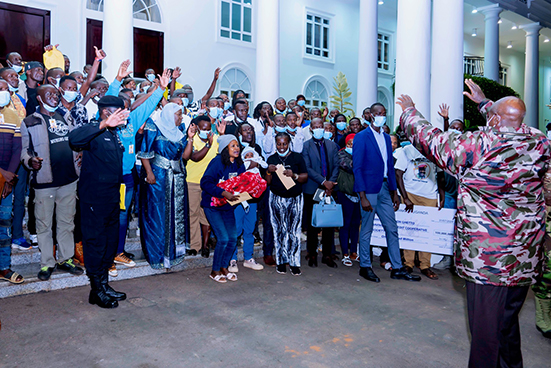
“The wananchi, including the ghetto people, don’t use the weapon which we gave you to deal with the people who don’t work for you. The gun we gave you is that of electing the people who speaks for you if they don’t speak for you, bring them back. We removed the monopoly of power from the administrators and gave you the power to vote your own leaders who speak for you” the President said during a meeting with 100 leaders of ghetto youth Saccos in Kampala, Wakiso and Mukono areas at State House.
A furious Museveni noted that these fake MPs not only fail to speak for the people, but some of them have even become real thieves but voters simply look on instead of terminating their contract with such leaders.
“They even join corruption, and you don’t follow them up. Why don’t you bother to find out? If we bring programs and you don’t follow them, whom do you blame?” he inquired.
According to the President, the problem of the ghetto people started when the educated people (elite) failed to deal with the uneducated. He however, noted that even the iliterates have had their own weaknesses like the failure to hold their elected leaders accountable.
He said on top of the government workers like the chiefs who existed during the time of the British (colonialism), when the NRM government came to power, they decided to add on leaders elected by the people from Local Council 1 up to LC.5 (district level) including a Woman Member of Parliament for each district to fill the gap in case the government chiefs failed to perform their roles.
“When we were preparing, I said, you people, to defend the people, we must add another structure, these ones should be elected by the people themselves so that the people’s delegates are there to monitor and hold the government accountable. That is why we created the LCs and MPs to be elected by you people. As people who have power in your hands, why do you go on to elect useless people?” he fumed.
Museveni’s outbursts come at a time when the masses especially the youths are agitated with the happenings in parliament which has seemingly become a symbol of corruption in the country. Already, through the President’s efforts working with his security agencies, five legislators are behind bars courtesy of theft of public funds, fraud and related cases while the youth a few days ago also took to the streets to demand for action on the unprecedented corruption in this institution.
BACK TO STATE HOUSE
Museveni told the ghetto youth leaders that the ghetto people whom he kept referring to as ‘Abawejjere’ have been pivotal in shaping Uganda’s political journey starting way back before Uganda’s self rule.
As a person, the president said he started working with ghetto people in 1968 and therefore, any suggestions that he’s a stranger to ghetto life is simply untrue.

“What you call ghetto people, in the 1950s used to be called ‘Abawejjere’ and they were centred around Katwe. When Uganda was fighting for Independence, much of the activities were around Katwe and I think the first offices of the Uganda National Congress were located in Katwe and that is where I think Dr. I.K Musazi and Dr. Barnabas Kunuka and others operated from. Even Augustino Kamya who organized the boycott of Indian goods in 1958 was from Katwe,” the President recounted.
He went on: “I linked up with the ghetto in 1968. I was there, Katwe is my place. I was not a ghetto boy myself; my background is in the villages with farmers. That is where I came from to go to university, but we (Student movement) wanted to link up with the ‘Bawejjere’.
The Head of the abawejjere that time was Abbas Kibazo whom they used to call ‘Ss’abawejjere’ so I linked up with them. So, this story of saying this is my first time to link up with the ghetto is not true,”
President Museveni explained that when former President Gen. Idi Amin announced his coup on the 25th of January, 1971, the former students together with the help of the Abawejjere decided to fight him because they believed in solving the problems of the people.
“We had and still have a program of the prosperity of the people and Idi Amin could not understand that. Of course, we had problems with Obote, but we were at least able to talk to him. That is why we had not taken the route for fighting. On the 27th of January 1971, I left to fight Amin, so he ruled me for only 2 days. I left with two people from Kampala; Abbas Kibazo and Zubair Bakari and when we went to Mbarara, the people there added some other two chiefs. The five of us entered Tanzania where we met Mwalimu Nyerere and that’s how the fight against Idi Amin started. All the time when we were fighting Idi Amin, I used to come to Kampala and my contacts were mainly these bawejjere,” he said.
He said in 1971, they also recruited Ahmed Seguya who was from Katwe.
“He was among the 14 fighters I sent to Mozambique for training. When we went for the second battle in 1981 to fight Obote, Ahmed Seguya was our first army Commander but he died due to liver problems. Amin used to emphasize politics of identity based on religion saying he was fighting for Islam yet there was nothing he was doing for Muslims and other people also. During that time when I used to come to Kampala, I used to stay with my bawejjere contacts who were mainly Muslims.”
The President further assured the ghetto youths that his government is pro- people that emphasizes politics of interest and works for all Ugandans. Museveni also rallied the ghetto youths to hold their leaders accountable and demand what is meant for them.
He also tasked the ghetto youths to advocate for the interests of the masses like free education for all and prosperity for all as well as embracing government poverty alleviation like the Parish Development Model (PDM) to uplift their livelihoods. He cautioned them against destroying their country through illegal protests.
“This is your country and home, you should defend it, you shouldn’t get involved in criminality like illegal protests. Don’t be used by politicians with selfish motives who always land the ghetto youth into criminality” he advised.
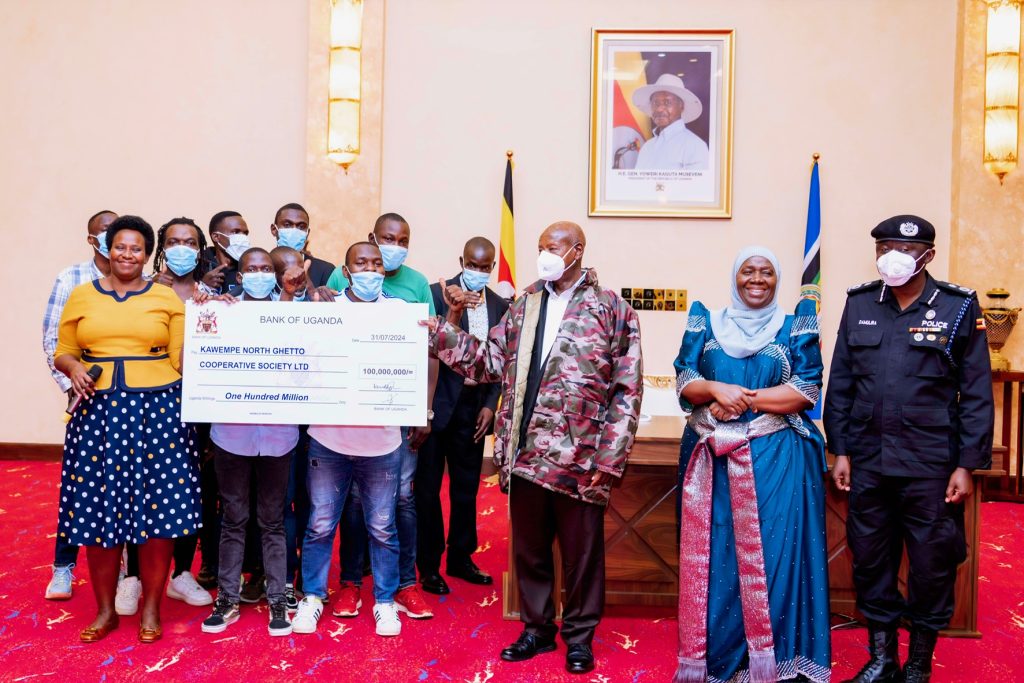
President Museveni also fulfilled his Shs1.2 billion pledge to the 12 ghetto SACCOs (Shs100 million each) in Kampala Metropolitan Area which he had promised to give them during a meeting at Kololo Independence Grounds last year.
“From the Shs100 million you can do something for yourselves. In the villages, we’re encouraging people go into commercial farming. It’s good that you have a base here in the town where you have small businesses, artisanship, services like salons and others. Those are areas you should participate in within your groups (constituencies),” the President told the youths.
The beneficiaries of the SACCOs are from; Rubaga Kakeeka Zone dwellers, Kasangati Ghetto Community, Kampala Central Division, Nakawa Division, Makindye East, Kawempe South, Makindye west, Kawempe North, Mukono industrial, Kasokoso, Nansana division and Masajja Para Zone ghetto in Makindye.
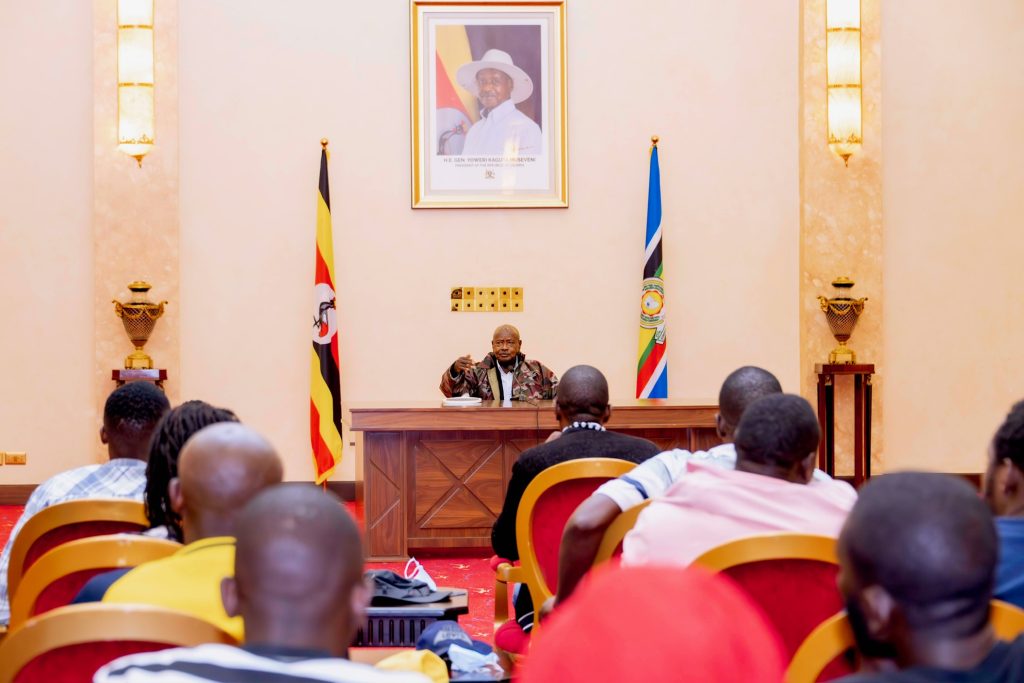
The meeting was attended by among others Minister Minsa Kabanda, Brig. Christopher Ddamulira, Jane Barekye and Hillary Musoke Kisanja.